
Plantar Fasciitis and Slippers: A Plain Guide for Indian Homes
Quick answer: For plantar fasciitis, podiatry guidance points to cushioned heels, good arch support and a firm, stable base, and away from flip-flops and backless slippers. The NHS says so directly. A soft slipper can make walking at home more comfortable, but treatment also needs stretching, load management and sometimes insoles or a night splint. See a doctor if pain has not eased after two weeks, or sooner if you have diabetes or numbness.
What Plantar Fasciitis Is and How It Feels
The plantar fascia is a thick band of tissue under the foot that runs from the heel bone to the base of the toes. The NHS page on plantar fasciitis describes it as strain on that band, and notes that it is often unclear why it happens. The typical pattern is pain on the bottom of the foot around the heel and arch, worst with the first steps after sleeping or resting, easing as you move and returning after long standing or walking. Stretching the sole, for example climbing stairs or raising the toes, can hurt.
The NHS lists several risk factors: being 40 to 60 years old, starting exercise on hard surfaces, a tight calf or heel, a lot of standing or walking, a sudden jump in activity, shoes with poor cushioning or support and being overweight. Notice how many of these are about load and footwear. That is why slippers come up so often, because many people spend long hours in thin flat chappals on hard floors.
What Footwear Advice Actually Says
Different sources agree on the broad points. The NHS advises shoes with cushioned heels and good arch support, the use of insoles or heel pads, and avoiding high heels, tight pointed shoes, flip-flops and backless slippers. The 2023 APTA clinical practice guideline on heel pain covers a wider set of treatments including stretching, taping, orthoses and education. A podiatry leaflet from Livewell Southwest NHS also recommends supportive footwear in place of walking barefoot.
There is no “best shoe for plantar fasciitis” that suits everyone. Consumer health sites such as GoodRx say much the same: choose arch support, cushioning and a slight heel, and talk to a podiatrist if you are unsure because flat feet and high arches need different support. For our readers that translates into a short set of checks, covered below.
Six Checks for a Plantar Fasciitis Slipper
- Cushioned heel. Press with your thumb for two seconds. A good heel dents and recovers.
- Arch contour. A gentle rise under the arch, not a hard hump. If it presses painfully, it is wrong for your foot.
- Stable base. The sole should bend at the toes but resist folding or twisting in the middle.
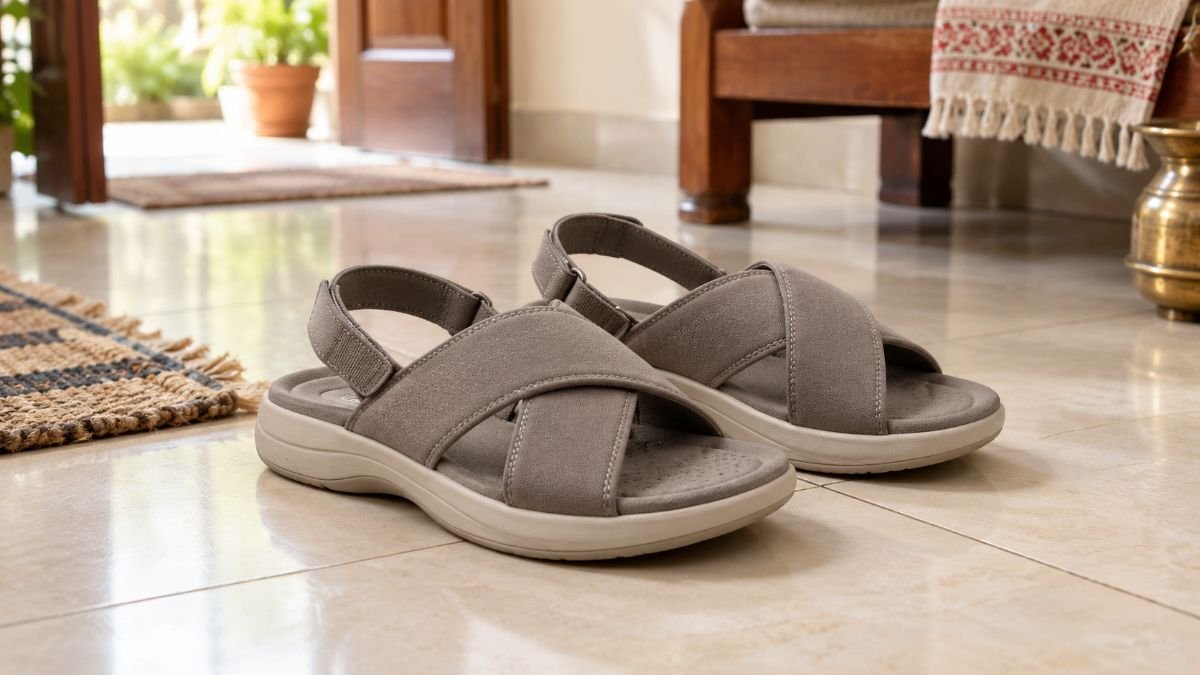
- Heel hold. A back strap or closed heel, because backless slippers are on the NHS avoid list.
- Not too flat. A slight heel rise can ease calf and fascia load, while a paper-thin flat sole offers nothing.
- Fit. The foot should sit within the footbed, not hang over the edges.
Slippers and Heel Pads Shoppers Often Compare
These are examples of slippers and a heel pad listed online. They are not treatments for plantar fasciitis. If pain lasts, see a doctor or podiatrist.

Frido Cloud Comfort Slippers for Women and Men
Listed with two options: with arch support and without. Pick deliberately.
Check the options
YOHO ArchFlex Orthopedic Slippers for Men
Listed with arch support, anti-skid soles and light weight.
Compare on Amazon.in
YOHO ArchFlex Orthopedic Slippers for Women
Listed with arch support, anti-skid soles and light weight.
Compare on Amazon.in
Silicone Gel Heel Cups for Heel Pain (Men and Women)
A heel cushion pad that goes inside a shoe or slipper with a closed heel. Listed for heel and ankle discomfort, not a treatment.
Check on Amazon.in
Doctor Extra Soft Thong Arch Support Slippers for Men (D-38)
A thong-style men’s slipper listed with arch support.
Check size and price
Doctor Extra Soft House Slipper for Women
The listing mentions MCR, orthopaedic, diabetic and acupressure features.
Check size and priceTry them on in Chennai
If you are in Chennai, you can try MCR and MCP chappals in person at our Choolaimedu store (No. 223, Choolaimedu High Road, near Gangai Amman Kovil, Chennai 600094). We are a footwear shop, not a clinic. WhatsApp us to check what is in stock before you travel.
What the Research Says About Footwear and Inserts
Research on mechanical treatments is mixed but broadly supportive of using them as part of care. A 2020 systematic review in the Journal of Sport Rehabilitation pooled 43 studies with 2,837 patients across inserts, orthoses, taping and shoes. A 2019 network meta-analysis by Babatunde and colleagues is listed on the NHS Scotland orthotics evidence portal. An earlier review in the Journal of Multidisciplinary Healthcare compared customised foot orthoses with corticosteroid injection. The exact effects vary by study, and many involved shoes and inserts together rather than slippers alone.
A randomised trial of moulded flip-flops is worth a note because it speaks to slippers directly. In 108 adults with foot pain the improvement over 12 weeks was statistically significant but below what the researchers considered clinically important, so Chuter and colleagues frame such footwear as a helpful extra, not a standalone treatment.
Why the First Steps Hurt Most
The NHS notes that plantar fasciitis pain is usually much worse when you first walk after sleeping or resting, then eases as you move. Many people describe it as a stab or a bruise under the heel. The foot has been still for hours, so the tissue is stiff and the first load comes through a barely warmed-up heel. That is why the footwear you put on first thing matters more than the pair you wear mid-afternoon. A supportive slipper beside the bed is a small change that avoids the cold-tile barefoot walk. The Livewell Southwest leaflet makes the same practical point.
If your pain follows a different pattern, for example constant, burning, or worse at night, mention that to a doctor. The pattern is one clue that separates plantar heel pain from other problems such as nerve irritation.
Where MCR and Soft Slippers Fit In
Many readers ask whether MCR chappals suit plantar fasciitis. MCR (micro cellular rubber) is a soft, resilient foam, and the research origin of Indian MCR footwear is in therapeutic programmes, as described in the Journal of Foot and Ankle Research paper on MCR. That does not make every MCR slipper a plantar fasciitis treatment. A soft slipper with a thick heel and a strap can be a comfortable choice at home. A very soft flat slide with no arch contour and no heel hold may feel nice at first and offer little support. Read our guides on MCR chappals for heel pain and what MCR slippers are.
Common Mistakes When Buying Slippers for Plantar Fasciitis
- Buying on softness alone. A pillow-soft slide feels good in the shop and may bottom out in a month.
- Ignoring the back of the slipper. If the heel slides, your toes grip to keep it on, which strains the foot.
- Choosing a hard arch bump. A support that presses painfully is worse than none. A gentle contour is easier to live with.
- Wearing a worn pair too long. Compressed foam gives no cushioning.
- Expecting the slipper to do all the work. The NHS also lists stretching, rest, ice, weight and low-impact exercise.
- Treating a label as proof. Words like orthopedic and medicated are not graded. See our guide on what the orthopedic label means.
Slippers, Shoes and Barefoot Through the Day
A realistic routine splits the day into three parts. At home in the morning, put supportive slippers on before the first step. During the working day, a closed shoe with a cushioned insole is usually better than any slipper, especially if you stand for hours. In the evening, a soft slipper gives the foot a break. Avoid walking barefoot on hard floors, which the NHS advises against.
| Time | Footwear idea | Why |
|---|---|---|
| First steps after waking | Supportive slipper by the bed | The foot is stiffest after rest |
| Work or errands | Closed cushioned shoe, or an enclosed supportive sandal | More heel hold and cushioning than an open slide |
| Evening at home | Soft slipper with a heel strap | A kind surface for tired feet |
| Bathroom and wet floors | A grippy slipper kept separately | Soft foam can be slippery when wet |
General footwear habits, not medical advice.
Body Weight, Standing Hours and Hard Floors
Two of the NHS risk factors, standing for long periods and being overweight, both increase the load through the heel with every step. Heavier wearers generally need a denser, firmer foam that does not compress fully, a point we explain in our guide to MCR and EVA densities. People who stand for hours, such as shopkeepers, cooks and teachers, often do better in a closed supportive shoe during work and a soft slipper afterwards. Hard Chennai floors add to the effect, so a rubber mat in a kitchen or at a counter can help as much as any footwear change.
If you are overweight, the NHS lists weight loss as part of what helps. That is a sensitive subject and a slow one, so treat it as a long-term goal alongside the shorter-term footwear steps.
Other Things the NHS Suggests
Footwear is one piece. The NHS suggests resting and raising the foot when you can, applying an ice pack wrapped in a towel for up to 20 minutes every two to three hours, doing regular gentle stretches of the sole and heel, choosing low-impact exercise such as swimming, and losing weight if you are overweight. Painkillers such as paracetamol or ibuprofen may help, and a pharmacist can advise. If it does not improve, a physiotherapist or podiatrist can offer exercises, insoles, night splints, injections or shockwave therapy.
Buying for a Parent With Heel Pain
This is a common visit to our shop. Three practical points help. First, make sure they have had the pain looked at if it has lasted more than a couple of weeks, because heel pain in older adults has several causes. Second, choose a pair they can put on and take off easily, with a fastening they can manage. Third, think about slipping. A soft sole on a wet bathroom tile can be a fall risk, so keep a grippy pair for the bathroom. If your parent has diabetes, read our diabetic slippers guide first.
What Not to Wear
- Flip-flops and backless slippers, which the NHS advises avoiding.
- Paper-thin flat chappals.
- Worn-out foam that has lost its spring.
- High heels and tight pointed shoes.
- Walking barefoot on hard floors for long periods.
Who Should See a Doctor First
- Severe pain or pain that stops normal activity.
- Pain that is getting worse or keeps returning.
- No improvement after two weeks of self-care.
- Tingling or loss of feeling.
- Diabetes with any foot pain.
For people with diabetes, see our guide on diabetic slippers, because the safe choices differ.
Choosing in Chennai
Chennai floors are hard and the weather is hot, so cushioning and grip both matter. Visit a shop where you can test a pair on a hard floor. At our Choolaimedu shop you can press the heel, fold the sole and walk a few steps in different MCR, MCP and EVA slippers. Bring your current pair if the pain is on one side, because the wear pattern can help show where the support is failing.
When to Replace Your Slippers
Replace slippers when the heel no longer rebounds, the sole has worn unevenly, the footbed has a dent where your heel sits or the strap has stretched. Foam type, body weight and daily hours all change how long a pair lasts. Compare an old pair with a new one if you are unsure.
Frequently Asked Questions
Are slippers good for plantar fasciitis?
Some can be. The NHS advises cushioned heels and good arch support and says to avoid flip-flops and backless slippers. A soft slipper with a thick heel, arch contour and heel strap is a reasonable home choice, alongside other treatment.
Are MCR slippers good for plantar fasciitis?
A thick, springy MCR slipper with a heel strap can be comfortable, but MCR is a material, not a treatment. Check the heel, arch and base.
Should I walk barefoot at home with plantar fasciitis?
The NHS advises trying not to walk barefoot on hard surfaces.
How long does plantar fasciitis take to improve?
It varies. The NHS advises seeing a GP if it has not improved after two weeks of self-care.
Do I need an insole as well as slippers?
Some people do. The NHS mentions insoles and heel pads, and a pharmacist, physiotherapist or podiatrist can advise.
Are flip-flops bad for plantar fasciitis?
The NHS lists flip-flops among footwear to avoid for plantar fasciitis.
Can I wear slippers all day at work?
A closed supportive shoe is usually better for long working hours. Use slippers for home.
Is plantar fasciitis the same as a heel spur?
No. A spur is a bony growth that can exist without pain, and pain often comes from the soft tissue. See our heel spur guide.
The Short Version
For plantar fasciitis choose slippers with a cushioned heel, arch contour, stable base and heel hold, and avoid flip-flops and backless styles. Use them alongside stretching and load management, and see a doctor if the pain lasts beyond two weeks or you have diabetes or numbness.
Keep Reading
Related guides
Chennai
Sources
- NHS: Plantar fasciitis
- APTA / AOPT: Heel pain, plantar fasciitis clinical practice guideline, 2023 revision (Koc et al., JOSPT 2023;53(12):CPG1-CPG39)
- Livewell Southwest NHS podiatry: Plantar heel pain syndrome patient leaflet, 2025
- Chuter, Searle, Spink: Flip-flop footwear with a moulded foot-bed for the treatment of foot pain, a randomised controlled trial, BMC Musculoskeletal Disorders 2016
- Paul, Rajkumar, Mendis: Micro Cellular Rubber (MCR), a boon for leprosy affected patients, J Foot Ankle Res 2014
- Effectiveness of mechanical treatment for plantar fasciitis: a systematic review, J Sport Rehabil 2020
- NHS Scotland: Evidence for orthotic treatment of the plantar heel
- GoodRx: Shoes for plantar fasciitis
- Uden et al.: Plantar fasciitis, to jab or to support? J Multidiscip Healthc 2011
Some links on this page are affiliate links, so we may earn a small commission on qualifying purchases at no extra cost to you. See our affiliate disclosure. Foot-health content here is general information, not medical advice.


