
Orthopedic Slippers for Men: What the Label Means and How to Choose a Pair
Quick answer: “orthopedic” on a men’s slipper is a marketing word, not a guarantee. It usually means a cushioned, contoured footbed and a softer sole. That can make daily wear more comfortable, but it is not a medical device. If you have diabetes, numb feet or lasting pain, see a doctor before choosing footwear yourself.
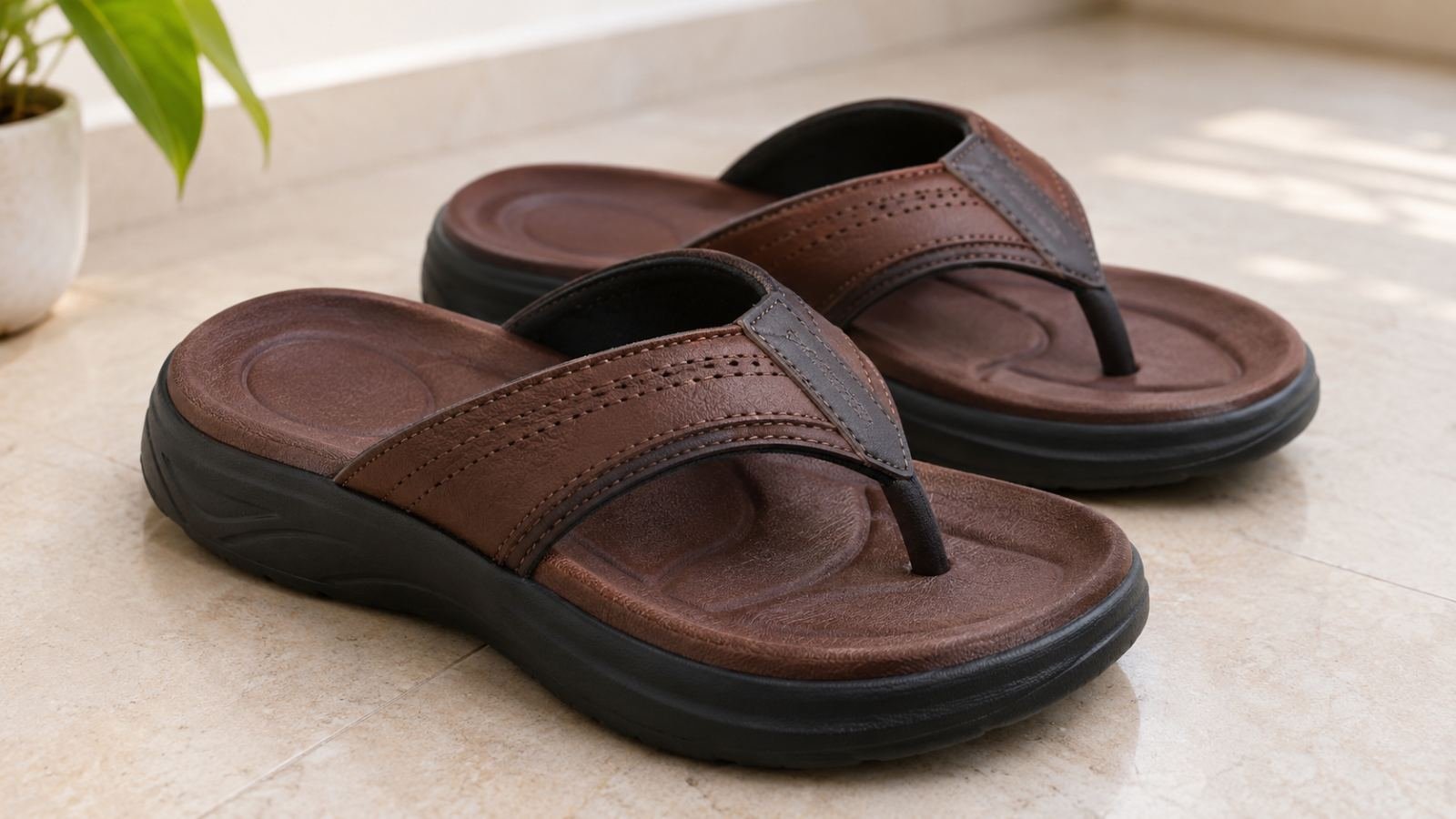
What “Orthopedic” Means on a Men’s Slipper
Shops and sellers in India use “orthopedic” for any slipper with extra cushioning or a shaped footbed. The word is not tied to a test you can check on the box. A report on the Bureau of Indian Standards says IS 19956:2026 for therapeutic footwear was established in October 2026, and the 2025 draft covers footwear for diabetes, neuropathic feet and people at high risk of foot ulcers. That is a standard for therapeutic footwear, not for every slipper called orthopedic.
So read the word as “designed to be soft and supportive”, and judge the pair on what you can see and feel.
Common Labels and What to Check Instead
| Label on the box | What it usually means | What to check yourself |
|---|---|---|
| Orthopedic | Soft sole and a shaped footbed | Press the sole, feel the arch, check the heel strap |
| Doctor soft | Extra-soft foam | Does it spring back, or stay dented? |
| Memory foam | Slow-recovery foam | Check thickness and whether it flattens under weight |
| Acupressure | Bumps on the footbed | Whether the bumps are comfortable for you. They are not therapeutic by default |
| Diabetic | Wide fit, soft interior | Not prescription footwear. See our diabetic slippers guide |
| MCR / MCP / EVA | Different foam trade names | Read our MCR vs MCP and MCR vs EVA guides |
None of these labels is a certification on its own. A real therapeutic standard exists, but it is a different category (see above).
What Orthopedic-Style Slippers Can Help With
- Comfort on hard floors. The NHS advice for sore heels is wide, comfortable footwear with a low heel and soft sole, and soft insoles or heel pads. A cushioned slipper meets that.
- Fewer barefoot hours. NHS guidance suggests avoiding barefoot walking on hard floors until pain settles.
- Everyday relief, not a cure. The APTA guideline recommends orthoses together with other treatment for plantar heel pain, not on their own for acute pain. No study shows that a slipper treats a foot condition by itself.
For a similar comparison on the MCR side, see our MCR slippers for men guide.
Cushioned Men’s Slippers online
Examples listed online. These are cushioned slippers, not medical devices. Check size charts and return terms on the page.

Doctor Extra Soft Ultra Cushion Slippers for Men
Listed as lightweight men’s slippers for orthopedic and diabetic use.
View on Amazon.in
Doctor Extra Soft Thong Arch Support Slippers for Men (D-38)
A thong-style men’s slipper listed with arch support.
Check size and price
Doctor Extra Soft Men Flip Flop
A men’s flip-flop style listed under the Doctor Extra Soft range.
See it on Amazon.in
Ortho + Rest Men Slipper
Listed as a super soft, lightweight men’s flip-flop for home and daily use.
See it on Amazon.in
YOHO ArchFlex Orthopedic Slippers for Men
Listed with arch support, anti-skid soles and light weight.
Compare on Amazon.in
Doctor Health Super Soft Men's EVA Flip Flops
A thong-style EVA (not MCR) men’s slipper, useful as a comparison for softness.
See it on Amazon.inTry them on in Chennai
If you are in Chennai, visit our Choolaimedu store (No. 223, Choolaimedu High Road, near Gangai Amman Kovil, Chennai 600094) to press and compare MCR and MCP chappals for men on the shelf. WhatsApp us to check what is in stock.
Heel Pain and Plantar Fasciitis in Men
The NHS says plantar fasciitis mainly affects people aged 40 to 60, and that standing, walking or running a lot, wearing shoes with poor cushioning or support, a tight calf and being overweight raise the risk. Its self-care list includes cushioned heels, good arch support, insoles or heel pads, gentle stretches, rest with the foot raised, ice for up to 20 minutes every two to three hours, and avoiding flip-flops and backless slippers. See the NHS plantar fasciitis page. Most orthopedic-style slides are backless, so if heel pain is your reason for buying, choose a closed or back-strap style.
The APTA’s 2023 clinical practice guideline for plantar heel pain recommends foot orthoses together with other treatments, not on their own for acute pain. A cushioned slipper is not a substitute for stretches or a visit to a doctor if the pain lingers.
Five Checks Before You Buy
| Check | What good looks like |
|---|---|
| Footbed shape | A gentle arch and heel curve that fits your foot, not a hard bump |
| Sole softness | Dents under a thumb and springs back slowly |
| Heel strap | A back strap or closed heel so toes do not grip to hold it on |
| Wide base | Sole wider than your foot for wet floor stability |
| Toe room | Space for toes to spread, with the strap not cutting in |
Try both feet. Most people have one slightly larger foot, so size to that one.
What Research Says About Thong Style and Flip-Flops
The Auburn University gait study cited above found shorter steps and more toe gripping in people wearing flip-flops. In the other direction, the 2016 Chuter trial in 108 adults with disabling foot pain used flip-flops with a moulded footbed and found pain improved by a statistically significant amount over 12 weeks, though less than the researchers had set as clinically important, and the authors suggested them as a helpful extra rather than a main treatment. Both can be true: the way a thong holds the foot is not ideal, and a well-shaped footbed can still be comfortable. For long wear, pick a heel strap.
Flat Feet and Orthopedic Slippers
The NHS describes flat feet as common and usually not a concern. It advises wide, comfortable shoes with a low heel, notes that supportive insoles may help, and says stretches, exercises and painkillers can ease pain or stiffness without changing the shape of the foot. It recommends seeing a GP if your feet are painful, stiff, weak or numb, if only one foot is affected, or if you did not have flat feet before. Read the NHS flat feet page. A contoured slipper may feel more comfortable for some people with flat feet, but a very high, hard arch bump can dig in. Try before you buy.
Who Should See a Doctor First
Talk to a doctor before choosing footwear if
- You have diabetes. The IWGDF 2023 guideline says people at risk of foot ulcers should not walk barefoot, in socks or in thin-soled slippers, and need properly fitting footwear. For some that means prescribed therapeutic footwear, not a shop-bought slipper.
- You have numbness, tingling or a wound on the foot.
- Heel pain has lasted more than two weeks, or follows an injury (NHS advice).
- You have swelling, one foot clearly flatter or different, or pain at night.
Work, Standing and Walking
If you stand all day, on a shop floor, in a workshop or behind a counter, comfort comes from cushioning that does not bottom out and from a base that stays stable. Heavier men should compare sole density, since a very soft sole can flatten. Our MCR guide for men explains the soft versus dense sole test.
One more point: flip-flop style thongs change how people walk. A study at Auburn University found shorter steps and toe gripping in flip-flop wearers. For long wear choose a back strap.
Older Men and Steadiness
For older men, steadiness matters as much as softness. The Keele University study found that enclosed slippers with a firm sole and a fastening gave better balance and gait results in older women than backless soft slippers, and most participants said they would consider wearing them. See the abstract. The Swansea Bay University Health Board also advises firm, supportive, ideally non-slip soles and avoiding backless, open-toed or high-heeled slippers for older people. A slipper with a thick, squashy platform can make steadiness worse.
Getting the Size Right
An orthopedic slipper with the wrong size does more harm than a plain one, because a shaped footbed only works if your foot sits where the shape expects it. Measure your foot in the evening, heel to longest toe, and compare it with the footbed length in centimetres. Your heel should sit fully on the footbed with the arch contour under your arch, not ahead of it. Most men have one foot slightly larger, so size to that one. CSIR-CLRI’s national foot-measurement drive across 79 districts exists because the sizing system India uses was adopted from other countries and does not always fit Indian feet, according to a Free Press Journal report, so do not trust the number on the sole alone.
Indoors, Outdoors and Bathrooms
Most orthopedic-style slippers are designed for indoor and short outdoor use. They are generally not made for long walks, for rough ground, or for wet bathroom floors, where a smooth foam sole can skid. If you need an everyday outdoor chappal, a back-strap style with deep tread is a better base. If you want something for the bathroom, keep a separate rubber pair with a channelled sole, because a soft foam footbed that stays damp can hold moisture. Never use a pair that has started to peel or crack underfoot.
Shop vs Online for Orthopedic-Style Slippers
| Point | In a shop | Online |
|---|---|---|
| Press the sole | Yes | No, rely on listing details |
| Check the strap | Yes, with your weight on | Only through photos and reviews |
| Size | Try both feet | Use footbed length in cm |
| Exchange | Often easy and same-day | Check the return window |
| Range | What the shop stocks | Wider choice |
A hybrid works well: try a pair in the shop, then reorder the same model when it wears out.
If a listing gives only “orthopedic” and “doctor soft” and not the footbed length, thickness or material, treat the claims as marketing.
Care, Hygiene and When to Replace
- Wipe with a damp cloth and dry in shade.
- The NHS suggests not wearing the same footwear more than two to three days in a row if you are prone to athlete’s foot, and drying between the toes. See the NHS athlete’s foot page.
- Replace when the footbed has a permanent dent or the tread is worn smooth.
Myths Worth Dropping
- “Orthopedic means prescribed by a doctor.” It does not. A prescribed device is made after an assessment.
- “Harder arch bumps work better.” A hard bump that does not match your arch can hurt.
- “It will fix my heel pain in a week.” The NHS notes plantar heel pain usually resolves fully, but it can take up to 12 months in some cases. Footwear is a comfort aid within that.
- “One pair for everything.” Different jobs need different pairs.
Ten-Second Questions That Cut Through the Label
- Does the footbed length in centimetres match my foot, with the heel fully on it?
- Does the sole spring back within a couple of seconds when I press it?
- Is the heel held by a strap or closed back?
- Is the tread deep enough that I would trust it on a wet tile?
- Would I be comfortable standing in it for an hour, not just walking ten steps in the shop?
If you answer yes to all five, the label matters very little. If you answer no to any of them, no label will fix it.
Shop Slippers vs Prescribed Footwear
It helps to see the two on one line. Prescribed therapeutic footwear follows a foot assessment and is made or fitted for a specific problem, for example for neuropathic feet or after an ulcer. The 2004 Chennai study in Diabetes Care tested prescribed MCR sandals, polyurethane foam sandals and moulded insoles, not shop slippers, in people with neuropathy, and reported new lesions in 33 percent of those wearing their own footwear against 4 percent of those wearing the prescribed pairs. A shop slipper can be very comfortable, but it has had no assessment of your foot. If you have any condition that reduces feeling in your feet, the comfortable choice and the safe choice may not be the same one, and your doctor should decide.
If you simply have tired feet after a long day, a good cushioned slipper that passes the checks above is a sensible purchase, and you do not need a prescription for it.
Trying a Pair in Chennai
At our Choolaimedu store you can press the soles, check the strap and compare a few styles side by side before choosing. Bring a pair you currently wear so we can look at where the wear is heaviest, which says a lot about your gait and what you need from a new pair.
Frequently Asked Questions
What does orthopedic mean for slippers?
In shops it means a cushioned, shaped slipper. It is not a regulated medical term, so judge the pair by its footbed, sole and fit.
Are orthopedic slippers good for men with heel pain?
They can make sore heels more comfortable, in line with NHS advice for soft soles and heel pads, but they do not treat the cause. See a doctor if pain lasts two weeks.
Are orthopedic slippers good for diabetics?
Not automatically. People with diabetes at risk of foot ulcers should follow their doctor’s footwear advice, and IWGDF guidance says to avoid thin-soled slippers.
Can I wear orthopedic slippers all day?
Cushioned slippers are fine at home, but a back strap and a stable base matter for long wear. Ask a doctor if you have foot pain.
What is better, MCR or EVA orthopedic slippers?
Neither is better by label. Compare actual softness, density and shape. See MCR vs EVA.
How do I check the size?
Measure the longer foot, leave toe room, and make sure the strap does not cut in.
Are flip-flop style orthopedic slippers okay?
They suit short wear. A study found shorter steps and toe gripping in flip-flop wearers, so choose a back strap for long wear.
Where can I try orthopedic slippers for men in Chennai?
Urban Style Footwear, Choolaimedu. WhatsApp +91 90808 61559.
The Short Version
“Orthopedic” tells you what the seller hopes, not what a test proved. Check the footbed, the sole, the strap and the fit. See a doctor if you have diabetes, numbness or pain that lasts.
Keep Reading
Orthopedic guides
Sources
- NHS: Heel pain
- APTA / AOPT: Heel pain, plantar fasciitis clinical practice guideline, 2023 revision (Koc et al., JOSPT 2023;53(12):CPG1-CPG39)
- IWGDF: Guidelines on the prevention of foot ulcers in persons with diabetes, 2023 update
- TeamLease RegTech: BIS notification establishing IS 19956:2026 Therapeutic Footwear, 14 October 2026
- BIS: Draft Indian Standard, Therapeutic Footwear Specification (MHD 09), July 2025
- BIS: IS 6721:2023 Sandals and Slippers, Specification (First Revision)
- Auburn University (Newswise): Overuse of flip-flops can lead to orthopedic problems
- NHS: Plantar fasciitis
- NHS: Flat feet
- Free Press Journal: CSIR-CLRI foot measurement and sizing initiative
- NHS: Athlete’s foot
- Keele University: Indoor footwear, balance and gait in older women
- Swansea Bay University Health Board: Slipper advice for older people
Some links on this page are affiliate links, so we may earn a small commission on qualifying purchases at no extra cost to you. See our affiliate disclosure. Foot-health content here is general information, not medical advice.


