
Memory Foam in Slippers: Plush at First, Worth It Only If You Choose Well
Quick answer: Memory foam is a slow-recovery viscoelastic polyurethane foam that softens with body heat and moulds around the foot. It feels plush and takes pressure off sore spots at first, but it can hold heat, lose shape and feel unstable on its own. In slippers, the best use is a memory foam top layer on a firmer, grippy base.
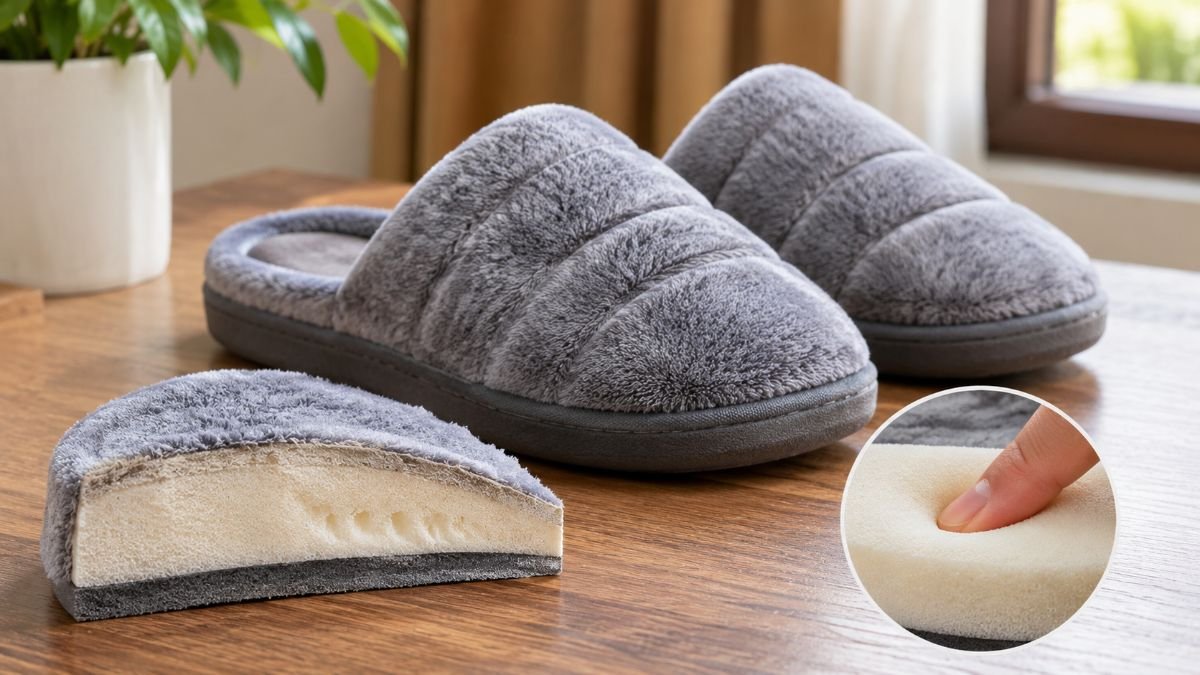
What Memory Foam Slippers Really Are
Memory foam is the common name for viscoelastic polyurethane foam, a material that compresses slowly under pressure and returns slowly afterwards. A footwear patent document describes it as typically made from viscoelastic polyurethane foam that moulds to the body in response to heat and pressure. Other industry sources call it slow-recovery or low-resilience foam.
In slippers, “memory foam” may mean a full thick sole, a thin insole layer or a layer glued over EVA or rubber. The label alone does not tell you how much memory foam there is, what density it is or what sits underneath. This guide explains how the material behaves, where it helps, where it disappoints and how to pick a pair. It is for everyday comfort and buying sense and does not treat any foot condition. For other materials, see our guide on slipper materials.
Why It Feels So Good at First
When you step into a memory foam slipper, the foam gives way under the heel and ball of the foot and slowly fills the gaps around your arch. Because the pressure spreads over a larger area, it can feel like walking on a cushion. Body heat softens the foam further, so the pair seems to adapt to your foot within minutes. For short periods of sitting and light walking, this is a genuinely pleasant feel, and it is why memory foam slippers sell so well as gifts.
Comfort is personal, though, and a soft feel in the first minute is not the same as support over a day. The material that makes the first step plush is the same one that can feel mushy and unstable when you stand or walk for longer.
The Trade-Offs
- Heat. An industry article from Sheela Foam notes that memory foam tends to retain heat because it reacts to body temperature, which can cause discomfort in warm climates unless ventilation is added. In Chennai, this matters.
- Stability. A thick, slow-recovery layer can feel unstable, especially for older adults, and may reduce the quick, springy response of regular foam.
- Durability. Repeated compression can leave low-density memory foam permanently flattened. Cheap pairs may flatten within a few months.
- Temperature sensitivity. Viscoelastic foam can feel firmer when cool and softer when warm, a behaviour noted in patent literature on such foams.
- Hygiene. Open-cell foam holds sweat. It can smell and stay damp if not dried well.
Cushioned Slippers Shoppers Often Compare
These are examples of cushioned slippers listed online. Check the listing for sole material and base, and check fit yourself. None is claimed to treat a condition.

Doctor Extra Soft Ultra Cushion Slippers for Men
Listed as lightweight men’s slippers for orthopedic and diabetic use.
View on Amazon.in
Doctor Extra Soft House Slipper for Women
The listing mentions MCR, orthopaedic, diabetic and acupressure features.
Check size and price
Ortho Joy Orthopedic Soft Slippers for Ladies
Listed as an MCR chappal for women for daily use.
See it on Amazon.in
MCR Healthcare Women's Orthopedic Soft Slippers
Listed as lightweight women’s chappals/sandals/slippers for orthopedic and diabetic use.
Compare on Amazon.in
YOHO ArchFlex Orthopedic Slippers for Men
Listed with arch support, anti-skid soles and light weight.
Compare on Amazon.in
Frido Cloud Comfort Slippers for Women and Men
Listed with two options: with arch support and without. Pick deliberately.
Check the optionsTry them on in Chennai
If you are in Chennai, you can try MCR and MCP chappals in person at our Choolaimedu store (No. 223, Choolaimedu High Road, near Gangai Amman Kovil, Chennai 600094). We are a footwear shop, not a clinic. WhatsApp us to check what is in stock before you travel.
When Memory Foam Slippers Make Sense
| Situation | Good fit? | Notes |
|---|---|---|
| Winter evenings indoors | Yes | Warmth is welcome |
| Short sitting and light walking | Yes | Plush feel works |
| Hot Chennai summer | Often not | Heat retention |
| Long standing in the kitchen | Not alone | Pair with a firm base |
| Older adults | Only with a stable, gripping base | Slow recovery can feel unsteady |
| Bathroom use | No | Absorbs water, dries slowly |
| Diabetic or numb feet | Ask a doctor | Heat and rough patches are risks |
For long hours on your feet, see our guide on slippers for standing all day. For stable footwear at home, read slippers for the elderly.
Look at What Is Under the Foam
The base of the slipper matters more than the foam on top. A soft memory foam layer on a firm, flat, grippy outsole gives you the plush feel and a stable platform. A thick memory foam slab with a thin, smooth bottom gives you a soft, wobbly slipper that slides on tile. Press down on the sole, fold the pair and look at the underside. If the outsole is smooth plastic or very thin, the foam may feel nice but the pair will be a slip risk. Our guide on non-slip slippers lists the tread to look for.
Density, Thickness and Recovery
Higher-density memory foam usually lasts longer and feels firmer, while lower-density foam feels softer at first and flattens sooner. Thickness changes the feel too: a thin layer of 5 to 10 mm adds comfort without much wobble, while a very thick pad can feel unstable. A quick shop test is to press your thumb into the foam and watch it return. Memory foam should recover slowly but completely within several seconds. If a dent remains after a minute, the foam is poor quality or already worn.
Memory Foam Compared With MCR and EVA
MCR is foamed rubber that tends to be springy and durable. EVA is light and cheap but can flatten. Memory foam is plushest but least stable and most heat retentive. A comparison of MCR and EVA covers the first two. Many good slippers combine materials, such as a firm MCR or rubber base with a thin memory foam top. That gives plushness where you feel it and stability where you need it. See EVA slippers for more on the lighter foam.
Will Memory Foam Help Foot Pain?
Some people with sore feet like the pressure-spreading feel of memory foam, and it can feel kind to a tender heel for short periods. There is no good evidence that memory foam slippers treat or cure any foot condition. The NHS advises that for plantar heel pain, supportive, cushioned footwear and sensible self-care are useful, and that a doctor should see pain that does not improve. A very soft slipper without a supportive base can be worse than a firm one. Read our guides on slippers for heel pain and whether slippers can cause foot pain before relying on softness alone.
Memory Foam in Hot, Humid Weather
If you wear memory foam slippers in summer, choose a thin layer, a breathable lining and a pair that you can wash and dry easily. Avoid thick fur or terry linings. Take them off when feet are sweaty, and let them air out. Consider a lighter, quicker-drying pair for the hottest months and keep the memory foam pair for cooler evenings and the monsoon season. The NHS notes that athlete’s foot thrives in warm, damp conditions, which is another reason to let a plush pair dry fully.
Gel and Cooling Memory Foam: Worth the Claim?
Some makers add gel particles, perforations or cooling fabrics to reduce trapped heat. Gel-infused versions were introduced to reduce the heat build-up of standard memory foam and to speed recovery, according to general references on the material. In footwear, the effect is modest, and the label “cooling” is not a guarantee. Look at the actual construction: perforated foam and a breathable lining help more than a marketing word. If a seller makes strong claims, ask what exactly is different about the foam, and judge it by how the pair feels after ten minutes on your feet in warm weather.
Memory Foam Myths
- “Softer means better for pain.” Very soft foam without a supportive base can let the heel sink and the foot roll. A mild, steady cushion is usually more comfortable over hours.
- “Memory foam is orthopedic.” The word describes how foam behaves, not a medical benefit. See what the orthopedic label means.
- “Thicker is better.” A very thick pad is unstable and can make you grip with your toes.
- “It will last for years.” Low-density foam often flattens within a season of daily use.
Who Should Skip Thick Memory Foam
A few groups are better served by a firmer, more stable pair. People with balance problems or a history of falls should prioritise a stable base and strong grip over plushness, as research on home footwear and falls, such as the MOBILIZE Boston study of older adults, points to footwear as a factor in indoor falls. People with diabetes or reduced foot sensation should talk to a doctor or podiatrist before choosing any soft footwear, because heat and hidden rough patches can injure feet without being noticed. And anyone who sweats heavily may find it uncomfortable in summer.
Buying Memory Foam Slippers as a Gift
Memory foam slippers are popular gifts because they feel nice in the hand. To make a gift that works, choose a size that suits the person, not a guess. Ask for the usual shoe size and allow for slightly wider feet in the afternoon. Pick a closed or strapped heel for older relatives, and choose a pair with a firm outsole. Keep the bill or ask the shop about exchange, since fit is hard to judge without trying a pair on.
Wearing Memory Foam Slippers Well
If you already own a memory foam pair, a few habits help. Use them for sitting and short walks rather than long periods on your feet. Take them off when your feet are sweaty and let the foam air out. Keep a firmer pair for kitchen work and the bathroom. Rotate two pairs if you can. Check the foam by pressing it every month: if it no longer returns, the pair has finished its useful life. Do not keep wearing a flat pad out of habit, since the heel will sit lower than the forefoot and can change how you walk.
Caring for Memory Foam Slippers
Spot clean the surface with a cloth and mild soap solution and avoid soaking the foam, since it absorbs water and dries slowly. Do not wring or squeeze hard, which can tear the cells. Dry in a shaded, airy spot and never in direct heat. Rotate two pairs. Replace when the foam stays flat after a few minutes or when the pair feels thinner under the heel. Our guide on slipper care covers a gentle routine.
How to Choose a Pair
- Check what sits under the foam: a firm, grippy outsole is essential.
- Press the foam and see how it recovers.
- Choose a moderate thickness rather than the thickest pad.
- Check that the heel is held and the toes do not grip.
- Look for a breathable lining if you live in a hot climate.
- Walk on a hard floor and on a smooth tile if possible.
- Buy a size that suits your afternoon foot.
Feel the Difference in Chennai
Memory foam is easy to judge in the hand and hard to judge on a screen. At our Choolaimedu shop you can press memory foam, EVA and MCR soles side by side, walk on a hard floor and see which one you actually prefer after a few minutes.
When to See a Doctor
If foot pain lasts 2 weeks or more, or you have numbness, swelling in one leg, non-healing wounds or diabetes, see a doctor. A soft slipper cannot replace a diagnosis. For what to look for in a slipper once a doctor has ruled out a condition, read our guide on comfortable slippers.
Frequently Asked Questions
What is memory foam in slippers?
A slow-recovery viscoelastic polyurethane foam that softens with body heat and moulds to the foot. It may be a full sole, an insole layer or a top layer over a firmer base.
Are memory foam slippers good for your feet?
They feel plush and can ease pressure for short periods, but they can be unstable and hot. Choose a thin layer on a firm, grippy base.
Are memory foam slippers good for foot pain?
There is no good evidence that they treat any foot condition. A cushioned but supportive pair may feel better than a flat one, and pain that lasts 2 weeks or more needs a doctor.
Do memory foam slippers get hot?
They can. Memory foam reacts to body heat and holds it, which can be uncomfortable in warm climates. Pick a thin layer and a breathable lining.
How long do memory foam slippers last?
Often a few months to a year with daily wear, depending on density, weight and care. Cheap low-density foam flattens sooner.
Can I wash memory foam slippers?
Spot clean with mild soap and a damp cloth, avoid soaking and dry in the shade. Do not use heat or a machine.
Are memory foam slippers safe for the elderly?
Only if the base is stable and grippy and the heel is held. A thick, slow-recovery pad on a smooth sole can feel unsteady.
Memory foam or MCR, which is better?
MCR is springier and more durable. Memory foam is plusher but less stable. A firm base with a memory foam top gives you both.
The Short Version
Memory foam slippers feel plush but can be hot, flatten sooner and feel unstable alone. Choose a thin layer on a firm, grippy base, check how the foam recovers and see a doctor for pain lasting 2 weeks or more.
Keep Reading
Chennai
Sources
- US Patent 10786034: Footwear having memory foam (describes viscoelastic polyurethane memory foam)
- Sheela Foam: Memory foam insoles vs regular shoe foam
- NHS: Plantar fasciitis
- NHS: Athlete’s foot
- Paul, Rajkumar, Mendis: Micro Cellular Rubber (MCR), a boon for leprosy affected patients, J Foot Ankle Res 2014
Some links on this page are affiliate links, so we may earn a small commission on qualifying purchases at no extra cost to you. See our affiliate disclosure. Foot-health content here is general information, not medical advice.


