
MCP Chappals Decoded: What Sellers Mean and What to Check Yourself
Quick answer: “MCP slippers” is a trade label with no single agreed definition in India. Sellers describe it as micro cellular polymer, polyurethane or a firmer rubber-like foam. So the three letters tell you little. Ask what the sole is made of, press it, check how it springs back, look at the seams and grip, and ask a doctor first if you have diabetes or numb feet.
What People Mean by MCP Slippers
Search for MCP slippers and you will find pairs sold as “MCP”, “MCR/MCP”, “MCP diabetic chappals” and “MCP orthopedic sandals”. The abbreviation is usually expanded as micro cellular polymer, and sometimes as polyurethane. Some pages describe MCP as firmer than MCR and aimed at diabetic feet, while others describe it as softer and lighter. That inconsistency is the main thing to know. No national standard or published paper fixes what MCP means, as we explain in our comparison of MCR vs MCP slippers.
This guide does not claim MCP is better or worse than anything else. It shows how to read a listing, what claims to treat carefully, which checks work in a shop and who should talk to a doctor before buying. It is general buying information and does not treat any foot condition.
Claims You Will See and How to Read Them
| Claim | What it may mean | What to ask or check |
|---|---|---|
| Micro cellular polymer sole | A foamed polymer sole, not always the same material | Which polymer, solid or foamed, what density |
| Doctor chappal or diabetic slipper | Marketing term, not a certification | Is there a standard or a doctor prescription behind it |
| Memory bounce | Foam that springs back | Press the sole and watch recovery |
| Anti-skid | A tread pattern | Look at the underside, test on wet tile |
| Lightweight | Low-density foam | Check it does not flatten sooner |
| Orthopedic | A label, not a fit guarantee | See our guide on orthopedic slippers |
| Non-allergic | Seller statement | Skin-test if you are sensitive |
| 3-layer or multi-layer | Footbed built from several materials | Ask what each layer is |
The honest summary is that none of these claims is checkable from a photo. They are starting points for questions, not proof.
What the Sole Might Actually Be
When a seller says MCP, the sole could be one of several things: a foamed polyurethane, a foamed EVA-type material, a rubber-like blend or a layered footbed with different foams on top and bottom. Each behaves differently. Polyurethane can be durable but heavier. EVA is light and soft but can flatten sooner, as the compression set explanation describes. A rubber-like foam may be closer to MCR, which the Journal of Foot and Ankle Research describes in therapeutic footwear. Our guides on slipper materials and EVA slippers explain each.
MCP and MCR-Labelled Slippers Shoppers Often Compare
These are examples of slippers listed online with MCP, MCR or cellular soles. Check the listing for the sole material and check fit yourself. None is claimed to treat a condition.

Doctor Extra Soft Ultra Cushion Slippers for Men
Listed as lightweight men’s slippers for orthopedic and diabetic use.
View on Amazon.in
Doctor Extra Soft House Slipper for Women
The listing mentions MCR, orthopaedic, diabetic and acupressure features.
Check size and price
Ortho Joy Orthopedic Soft Slippers for Ladies
Listed as an MCR chappal for women for daily use.
See it on Amazon.in
MCR Healthcare Women's Orthopedic Soft Slippers
Listed as lightweight women’s chappals/sandals/slippers for orthopedic and diabetic use.
Compare on Amazon.in
YOHO ArchFlex Orthopedic Slippers for Men
Listed with arch support, anti-skid soles and light weight.
Compare on Amazon.in
Ortho + Rest Ortho Slippers for Women
A women’s daily-use orthopedic flip-flop, per the listing.
See it on Amazon.inTry them on in Chennai
If you are in Chennai, you can try MCR and MCP chappals in person at our Choolaimedu store (No. 223, Choolaimedu High Road, near Gangai Amman Kovil, Chennai 600094). We are a footwear shop, not a clinic. WhatsApp us to check what is in stock before you travel.
Seven Checks in a Shop
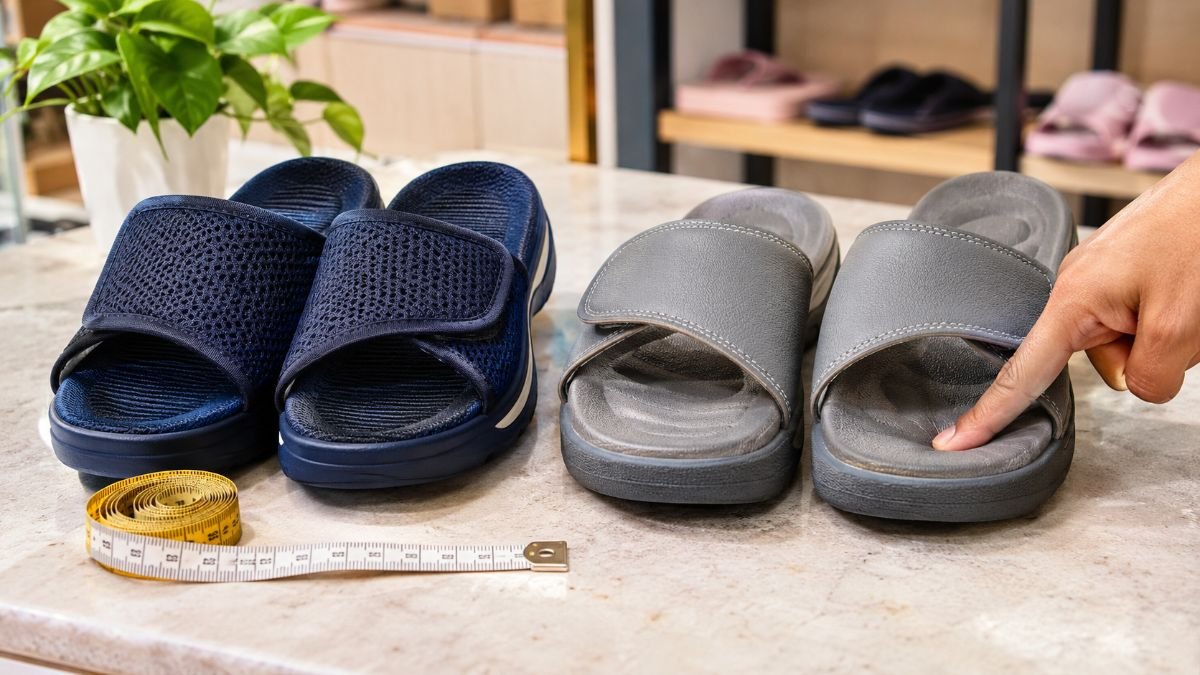
- Press the sole. It should dent and recover within a second or two. A lasting dent means poor foam.
- Fold the slipper. It should flex at the ball of the foot.
- Feel inside. No rough seams, staples, glue lumps or hard edges.
- Check the strap. Straps should anchor firmly and have a soft lining where they touch the skin.
- Look at the tread. Deep, even grooves grip better on wet floors.
- Check fit. A thumb of space ahead of the longest toe and no overhang at the sides.
- Walk. Make sure your toes do not grip to hold the pair on.
If You Have Diabetes or Numb Feet
Many MCP listings use the words diabetic or neuropathic. A pair labelled that way is not automatically safe for a diabetic foot. The International Working Group on the Diabetic Foot (IWGDF) guidelines on footwear and offloading stress that people at risk need properly fitting footwear, often assessed by a professional, and that every pair needs inspection for rough areas and foreign objects. Check inside with your hand before each wear. If you have loss of feeling, a past ulcer or foot deformity, talk to your doctor or a podiatrist before choosing any chappal. Our diabetic slippers guide goes through what to look for.
If You Want Heel or Arch Comfort
A soft MCP sole may feel good for tired feet, but it is not a treatment. The NHS advises that supportive, cushioned footwear and sensible self-care can help with plantar heel pain, and that pain that does not improve should be seen by a doctor. A flat, very soft slab can offer little arch or heel control. Our guides on slippers for heel pain and arch support slippers cover what to look for.
Price, Brands and Value
MCP slippers range from very low-cost pairs to premium brands. A higher price does not guarantee a better sole, and a low price does not make a pair bad. What matters is fit, foam quality and finishing. Brand names also vary in how openly they say what their materials are. A brand that names the material, shows a sole cross-section and gives clear size guidance is easier to trust than one that only says “MCP”. Ask about exchange and returns, since fit is hard to judge from a photo.
How to Read an Online Listing
- Look for the sole material in words. A listing that says only “MCP” gives you nothing. One that names the material and describes thickness is easier to trust.
- Check photos of the underside. You need to see the tread, not just the top.
- Read the size chart. Compare the foot length in centimetres with your own measurement. Our shoe size guide explains how.
- Check the return policy. Footwear fit is personal. A pair you can exchange is a safer buy.
- Be careful with medical claims. A listing that promises to cure pain or reverse a condition is overselling. Footwear can support comfort and does not treat disease.
- Read the one- and two-star reviews. They often mention flat soles, sizing problems and strap failures, which the five-star reviews skip.
MCP-Labelled, MCR and EVA at a Glance
| Label | Common description | What to confirm |
|---|---|---|
| MCR | Micro cellular rubber, foamed rubber | Density and tread |
| MCP | Micro cellular polymer or polyurethane, meaning varies | Material, density and recovery |
| EVA | Light foam plastic | Density, compression and grip |
This table describes how the words are commonly used, not a lab result. Two pairs with the same label can behave differently, which is why the shop checks above matter.
Who Tends to Buy MCP Slippers and What They Need
- Adults with tired feet from standing: a stable base, cushioning that recovers and a secure heel hold. Read slippers for standing all day.
- People managing blood sugar: a doctor-assessed fit and a seam-free interior.
- Older adults: grip and a heel hold above softness, as in our guide to slippers for the elderly.
- Women and men buying for daily wear: choose by fit and sole quality, not gender label. See our women and men guides.
Signs of Good and Poor Quality
| Sign | Good | Poor |
|---|---|---|
| Press test | Dents and recovers in 1 to 2 seconds | Stays dented |
| Edges | Smooth and sealed | Sharp or crumbly |
| Strap anchors | Firm, flush | Wobbly or pulling out |
| Tread | Deep and even | Shallow or smooth |
| Smell | Mild | Strong chemical |
| Weight | Light for its size | Heavy and stiff for no reason |
Where MCP Slippers Work Well
- Everyday home use on tile and cement floors, where cushioning helps.
- Short walks on dry pavement.
- Bathroom or wet areas only if the tread is deep and grippy.
- Light work and errands when you need a comfortable chappal that you can slip on and off.
They are not designed for hiking, running or heavy work, and a slipper is not safety footwear.
Why the Label Became Popular
The terms MCR and MCP spread in India through the therapeutic footwear market. The MCR story has a documented history, described in the Journal of Foot and Ankle Research paper on micro cellular rubber for people affected by leprosy. MCP, by contrast, grew as a sales term. As demand for soft, light chappals rose among people with diabetes, heel pain and tired feet, sellers began to describe soles with new letters. Some of these are real material differences, and some are simply branding. Because the language is not regulated, the best protection is to check the product yourself rather than rely on the abbreviation.
It also helps to remember that a medical-sounding word is not a medical device. In India, standards such as IS 6721:2023 for sandals and slippers cover general quality requirements, and a separate therapeutic footwear standard is described in our guide to BIS IS 19956. If a seller claims a standard, ask to see the details.
After You Buy: Breaking In and Checking
Wear a new pair for an hour on the first day and check your heels, toes and the tops of the feet for red marks. If you see rubbing, return or exchange it rather than hoping it will soften. After a week of daily use, press the sole again. A good foam recovers the same way it did in the shop. If it has already started to stay dented, the pair is low in density. Keep the bill for a month so you can exchange it. People with reduced foot sensation should check the inside of the slipper by hand before every wear and look at the feet each evening.
Caring for MCP Slippers
Because the material is uncertain, use the gentlest routine: mild soap, cool water, soft brush, rinse and dry in the shade. Avoid heat, bleach and machines. Our guide on MCR slippers care has a step-by-step routine that suits any foamed sole. Replace the pair when the sole is visibly flat, the tread is smooth or the strap is loose.
Common Buying Mistakes
- Trusting the letters instead of checking the sole.
- Buying a diabetic-labelled pair without a doctor opinion when you have risk factors.
- Choosing the softest pair and ignoring heel hold and grip.
- Buying by photo without a size chart or exchange option.
- Keeping a flattened pair because it still looks new.
Press and Compare in Chennai
At our Choolaimedu shop you can press MCR, MCP-labelled and EVA soles side by side, check the tread and try a fit. We would rather you understand what you are buying than rely on a label.
When to See a Doctor
See a doctor for foot pain that lasts 2 weeks or more, numbness, tingling, swelling in one leg, wounds that do not heal or any foot problem if you have diabetes. A slipper label cannot replace a diagnosis. For what to look for in everyday slippers, read comfortable slippers.
Frequently Asked Questions
What is MCP in slippers?
MCP is a trade label usually spelled micro cellular polymer, sometimes polyurethane. There is no single agreed definition, so ask what the sole is made of.
What is the difference between MCR and MCP?
MCR means micro cellular rubber. MCP is used differently by different sellers, so check the actual sole by pressing it and asking the maker.
Are MCP slippers good for diabetics?
A diabetic label is not a guarantee. People with diabetes should have their feet and footwear checked by a doctor or podiatrist and inspect inside each pair before wearing.
Are MCP slippers good for heel pain?
A soft, cushioned sole may feel comfortable, but there is no evidence that a label like MCP treats heel pain. See a doctor if pain lasts 2 weeks or more.
How do I know if an MCP slipper is good?
Press the sole to check it recovers, fold it to see where it bends, check seams, grip and fit, and ask what the sole is made of.
Do MCP slippers go flat?
Soft foam can compress over time. Replace a pair when the sole is visibly flat or the tread is smooth.
How do I clean MCP slippers?
Hand wash with mild soap and cool water, rinse and dry in the shade. Avoid heat, bleach and machines.
Are MCP slippers waterproof?
Foamed soles usually resist water, but a smooth sole can be slippery. Check the tread, and dry the pair fully between wears.
The Short Version
MCP is a loose trade label. Ask what the sole is made of, press it, check seams, grip and fit, and see a doctor first if you have diabetes, numb feet or pain lasting 2 weeks or more.
Keep Reading
Related guides
Chennai
Sources
- Paul, Rajkumar, Mendis: Micro Cellular Rubber (MCR), a boon for leprosy affected patients, J Foot Ankle Res 2014
- IWGDF: Guidelines on the prevention of foot ulcers in persons with diabetes, 2023 update
- Shoemakers Academy: Compression set, glossary
- NHS: Plantar fasciitis
- BIS: IS 6721:2023 Sandals and Slippers, Specification (First Revision)
Some links on this page are affiliate links, so we may earn a small commission on qualifying purchases at no extra cost to you. See our affiliate disclosure. Foot-health content here is general information, not medical advice.


