
MCR Sandals and Closed Shoes: What Changes When the Sole Comes With an Upper
Quick answer: MCR sandals and shoes use the same foamed rubber sole as MCR slippers but add straps or a closed upper. That helps hold the foot in place, which matters for walking, standing and outdoors. The upper then decides fit, ventilation and pressure points, so check width, toe room, seams and heel hold as carefully as the sole.
What MCR Sandals and Shoes Are
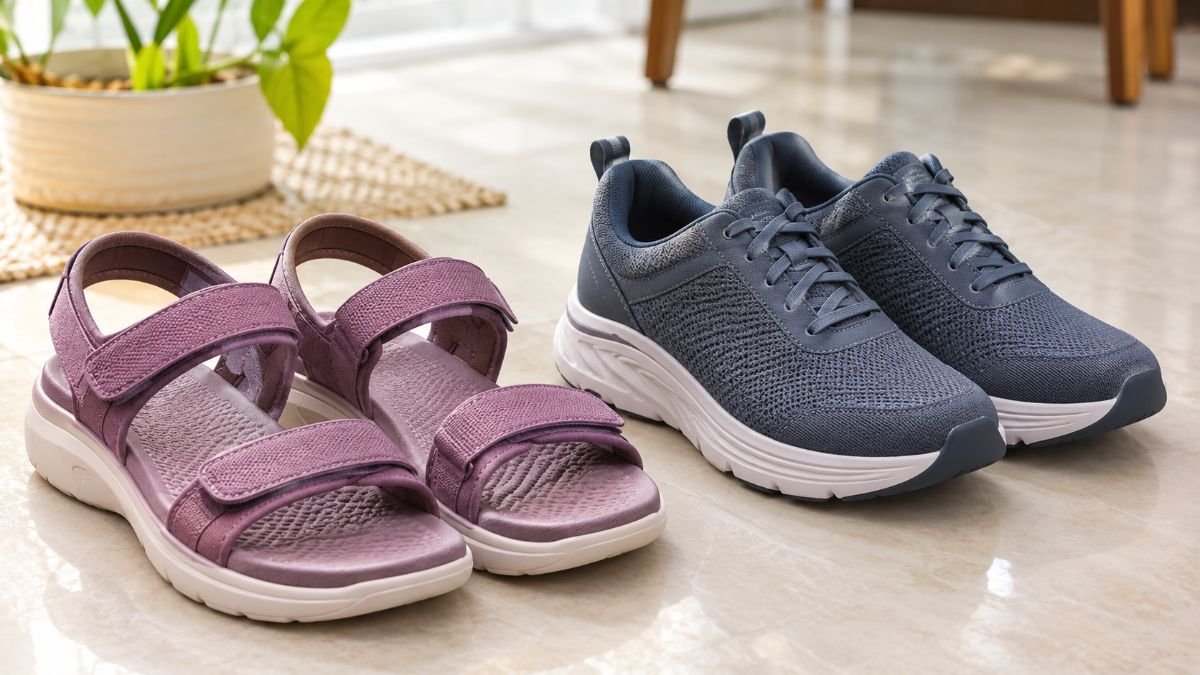
MCR stands for micro cellular rubber, a foamed rubber with tiny closed cells that makes soles light and springy. A paper in the Journal of Foot and Ankle Research describes its use in therapeutic footwear. In India, “MCR” appears on slippers, backstrap sandals, sports-style sandals and even closed shoes. The sole may be MCR or may only have an MCR footbed, and the upper is usually synthetic leather, fabric, mesh or moulded rubber. For the material itself, see our guide to MCR material.
This guide explains how sandals and closed shoes differ from slippers, when each is the better choice, what to check on the upper, and how to choose for walking, standing and daily errands. It is general buying information, not a treatment for any foot condition.
Why Choose a Sandal or Shoe Over a Slipper
A slip-on slipper relies on friction and a single strap to stay on. That is fine indoors, but outdoors, on stairs or when walking quickly it can make your toes grip. Sandals add a heel strap or ankle strap, and shoes enclose the whole foot. Both hold the foot more securely. Research on footwear and in-home falls in older people suggests that footwear that holds the heel and has a stable sole is better for balance than loose backless pairs, and the same logic applies outdoors. A pair that stays on lets you walk naturally and avoids the toe gripping that can tire the foot.
Slipper, Sandal and Closed Shoe Compared
| Style | Best for | Watch out for |
|---|---|---|
| Slipper (slip-on) | Indoors, bathroom, short trips | Loose heel, toe gripping |
| Backstrap sandal | Daily errands, standing, mild weather | Strap pressure on top of foot, buckle rubbing |
| Closed shoe | Longer walks, wet or rough ground, protection | Heat, fit, seams, less ventilation |
| Open sport sandal | Hot weather and walking | Sole too thin, strap rubbing |
No style is best for everyone. The right one depends on where you will wear it and how your foot shape and sensation are.
MCR-Style Footwear Shoppers Often Compare
These are examples of slippers and sandals listed online with MCR or cellular soles. Check the listing for which part is MCR, and check fit yourself. None is claimed to treat a condition.

Doctor Extra Soft Ultra Cushion Slippers for Men
Listed as lightweight men’s slippers for orthopedic and diabetic use.
View on Amazon.in
Doctor Extra Soft House Slipper for Women
The listing mentions MCR, orthopaedic, diabetic and acupressure features.
Check size and price
Ortho Joy Orthopedic Soft Slippers for Ladies
Listed as an MCR chappal for women for daily use.
See it on Amazon.in
MCR Healthcare Women's Orthopedic Soft Slippers
Listed as lightweight women’s chappals/sandals/slippers for orthopedic and diabetic use.
Compare on Amazon.in
YOHO ArchFlex Orthopedic Slippers for Men
Listed with arch support, anti-skid soles and light weight.
Compare on Amazon.in
Ortho + Rest Ortho Slippers for Women
A women’s daily-use orthopedic flip-flop, per the listing.
See it on Amazon.inTry them on in Chennai
If you are in Chennai, you can try MCR and MCP chappals in person at our Choolaimedu store (No. 223, Choolaimedu High Road, near Gangai Amman Kovil, Chennai 600094). We are a footwear shop, not a clinic. WhatsApp us to check what is in stock before you travel.
What to Check on the Upper
- Width and depth. Your foot should not be squeezed at the ball or pressed on the top. Feet swell during the day, so try pairs in the afternoon.
- Toe room. About a thumb of space ahead of the longest toe, and room to spread the toes.
- Seams and stitching. Run a hand inside. No hard ridges, staples or rough glue.
- Strap position. Straps should not cross over a bunion, a sore toe or a bony point.
- Adjustability. Velcro or buckles let you adapt to swelling.
- Material. Breathable fabric or mesh suits heat. Synthetic leather can trap sweat.
- Heel hold. A firm heel cup or strap that does not let the heel slide.
Sole Checks Still Matter
The sole checks from our slipper guides apply here too: press the sole and watch it recover, bend the pair and see where it flexes, and look at the tread. For shoes and sandals, the sole should also be stable enough not to twist when you hold the heel and toe and wring it. A sole that twists easily gives little support for long walks. Our guide on slipper materials lists the other materials you may see, and MCR vs EVA compares the common foams.
Where Each Style Works Best
- Daily walking and errands: a backstrap sandal or closed shoe with a stable sole and heel hold.
- Standing at work: a closed or strapped pair with a cushioned base. See slippers for standing all day.
- Monsoon: a quick-drying sandal with deep tread. Closed fabric shoes soak up water and dry slowly.
- Hot weather: open or mesh styles.
- Older adults: secure fastenings and a non-slip sole. See slippers for the elderly.
If You Have Foot Pain, Swelling or Diabetes
Closed shoes and sandals are not automatically better for sore feet. For forefoot pain, the NHS recommends footwear with enough room for the toes, and the NHS page on pain in the ball of the foot advises shoes that are not too tight with a cushioned sole. Podiatry leaflets, such as this Livewell Southwest footwear advice leaflet, describe features such as a robust, stable sole, a secure fastening and removable liners. For swollen feet, adjustable straps matter, as in our guide to slippers for swollen feet. For diabetes or reduced sensation, talk to a doctor or podiatrist before choosing, and see our diabetic slippers guide.
Getting the Size Right
Sandals and shoes are less forgiving than slippers because the upper limits how much your foot can move. Measure both feet in the afternoon, standing, and fit the larger one. Try pairs with the socks you will wear. Walk on a hard floor for a few minutes and check for rubbing at the heel, toes and top of the foot. If you are between sizes, choose the larger and use the adjustable strap. A narrative review in the Journal of Foot and Ankle Research found that many people wear footwear that does not suit the width or length of their feet, and that poor fit was associated with foot pain. See our shoe size guide for how to measure.
Closed Shoes: Extra Points to Check
A closed shoe has more parts that can go wrong. The heel counter, the cup at the back, should feel firm when you squeeze it, and it should hold the heel without rubbing the Achilles tendon. The toe box should have height as well as width, so toes can lift and spread. The tongue and lining should be smooth, with no ridges. A removable insole is useful because you can wash it, replace it or fit a doctor-prescribed insole if needed. Podiatry advice leaflets also mention a secure fastening such as laces or Velcro rather than a slip-on, since a fastened shoe holds the foot with less effort from the toes.
Heat is the main drawback in Chennai. Choose breathable mesh or perforated uppers, wear cotton socks or moisture-wicking socks and rotate two pairs. The NHS notes that athlete’s foot thrives in warm, damp conditions, so dry the pair fully between wears.
Sandals: Straps, Buckles and Pressure Points
Most sandal discomfort comes from straps. A strap across the top of the foot can press on tendons or a bony bump. A thin strap can cut in, while a wide soft strap spreads the pressure. A strap that crosses the joint of the big toe or little toe can rub if you have a bunion. A back or ankle strap should hold the heel without pinching. Buckles and Velcro should sit away from bony points. Try sandals with the strap adjusted to different holes and see where it presses after ten minutes of walking. If you cannot find a comfortable setting, the style does not suit your foot.
Choosing by Weather and Season
| Season | Better choice | Why |
|---|---|---|
| Summer | Open or mesh sandal, light slipper | Ventilation, quick drying |
| Monsoon | Quick-drying sandal with deep tread | Wet roads, grip, fast drying |
| Winter | Closed shoe or enclosed slipper | Warmth and protection |
| Festive or travel days | A comfortable closed shoe or strapped sandal | Long hours on your feet |
Keep a spare pair in the car or at the office. If your main pair gets wet, you can switch rather than wear a damp pair for hours.
A Five-Minute Fit Test
- Stand in the pair on a hard floor for one minute.
- Walk the length of the shop and back at a normal pace.
- Climb a step or two if there is one.
- Check for slipping at the heel and gripping toes.
- Press along the strap and upper for tight spots.
- Take them off and look for red marks on your feet.
If anything rubs in five minutes, it will hurt after five hours.
Men, Women and Unisex Pairs
Labels such as “for men” and “for women” mainly describe size range, colour and last shape. Women feet are on average narrower relative to length than men, but there is enough overlap that you should choose by your own foot rather than the label. If a pair marked for men fits your narrow foot loosely, or a pair marked for women squeezes your wide foot, switch. Our guides on MCR slippers for men and MCR slippers for women discuss sizing in more detail.
Watch the heel height too. Some women styles add a wedge or platform. That is fine for short wear, but a thick wedge can feel unstable and change how weight falls on the forefoot. See our guide on orthopedic slippers for women.
Online or in the Shop
Sandals and shoes are harder to buy online than slippers because upper fit matters more. If you do buy online, measure your foot in centimetres, compare with the maker size chart, read reviews that mention width and strap rubbing, and check that exchanges are allowed. Order your usual size and, if there is an adjustable strap, you have room for error. In a shop, take the time to walk, and try both feet, since one is usually larger. Whichever way you buy, keep the packaging and the bill for the exchange period, and wear the pair indoors first for an hour so you can return it if it rubs.
Care and Replacement
Wash straps and soles by hand with mild soap and cool water, dry in the shade and rotate two pairs. Check the heel counter and strap anchors every month. Replace a pair when the sole is flat, the tread is smooth, the strap loosens or the upper rubs. Our guide on MCR slippers care has a full routine, and the same principles apply to sandals and shoes. Avoid putting closed shoes in a washing machine or dryer, since heat can warp the sole and loosen the glue.
Common Mistakes
- Choosing a sandal with a very thin sole for long walks.
- Buying a closed shoe with a narrow toe box.
- Ignoring strap rubbing on the first fitting.
- Wearing wet fabric shoes for hours.
- Assuming the MCR label means the whole pair is orthopedic.
Try the Whole Pair in Chennai
At our Choolaimedu shop you can try sandals and shoes with the socks you wear, walk on a hard floor and test straps and fastenings. A pair that feels fine standing still can rub after ten minutes of walking, so give it a proper trial.
When to See a Doctor
See a doctor for foot pain that lasts 2 weeks or more, numbness, tingling, swelling in one leg, wounds that do not heal or any foot problem if you have diabetes. Footwear can support comfort but cannot replace a diagnosis.
Frequently Asked Questions
What are MCR sandals?
Sandals with a micro cellular rubber sole or footbed and straps that hold the foot, usually with a synthetic or fabric upper.
Are MCR shoes available?
Yes, some closed shoes use MCR soles or footbeds. Check the listing for what part is MCR and how the upper is built.
Are MCR sandals better than slippers?
They hold the foot more securely for walking and outdoors. Slippers are simpler and easier for indoors.
Are MCR sandals good for walking?
A stable sole, a heel hold and a roomy upper make a sandal better for walking. Very thin or loose pairs are not.
Are MCR sandals good for swollen feet?
Adjustable straps and a soft, roomy upper help. Choose a pair that does not leave pressure marks.
Are MCR sandals good for diabetics?
Talk to a doctor or podiatrist first and inspect inside each pair before wearing.
How do I wash MCR sandals?
Hand wash with mild soap and cool water, rinse and dry in the shade. Avoid heat, bleach and machines.
How long do MCR sandals last?
Often 6 to 12 months with daily use, depending on weight, surface and care.
The Short Version
MCR sandals and shoes hold the foot better than slippers. Check the upper for width, toe room, seams and heel hold, test the sole, and see a doctor for pain lasting 2 weeks or more.
Keep Reading
Chennai
Sources
- Paul, Rajkumar, Mendis: Micro Cellular Rubber (MCR), a boon for leprosy affected patients, J Foot Ankle Res 2014
- Footwear types and the risk of in-home falls in older people, PMC3250347
- NHS: Pain in the ball of the foot
- Livewell Southwest NHS podiatry: Footwear advice leaflet, 2025
- Buldt and Menz: Incorrectly fitted footwear, foot pain and foot disorders, J Foot Ankle Res 2018
Some links on this page are affiliate links, so we may earn a small commission on qualifying purchases at no extra cost to you. See our affiliate disclosure. Foot-health content here is general information, not medical advice.


