
Nodule Footbeds and Acupressure Claims: What Holds Up
Quick answer: Acupressure slippers have a footbed with small raised nodules or bumps meant to press on points of the sole. They feel like a foot massage and can be pleasant to wear. The evidence that this treats any condition is weak: a Cochrane Australia review of reflexology for the Australian government found very low certainty evidence on pain, and an earlier systematic review found no convincing benefit beyond placebo. Treat them as a comfort item, not a treatment, and avoid them if you have diabetes, numb feet, wounds or circulation problems.
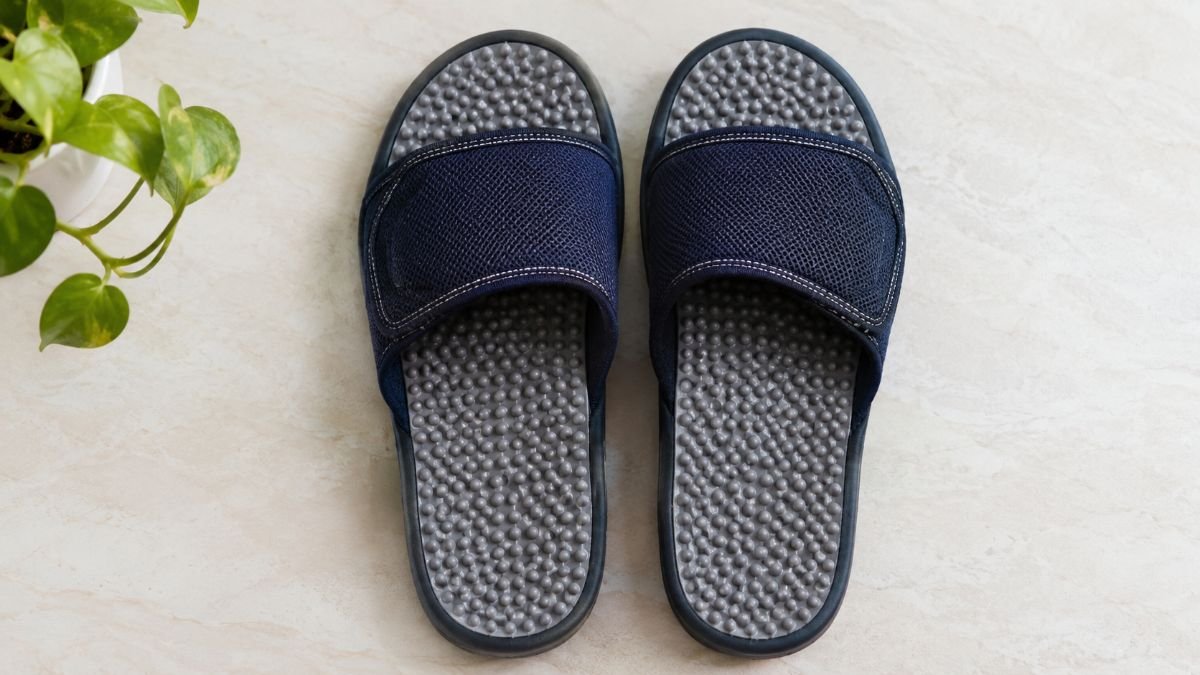
What Acupressure Slippers Are
An acupressure slipper has a footbed covered in raised bumps, ridges or magnets, designed to stimulate the sole as you walk. The marketing borrows from reflexology and acupressure, which hold that pressing certain points on the feet affects other parts of the body. In stores and online you will see them sold as “reflexology slippers”, “massage slippers” or “acupressure chappals”, often with claims about blood circulation, stress or pain.
This guide separates what the slipper physically does, a mild massage of the sole, from what it is said to do. It draws on systematic reviews rather than sellers, and it is meant to help you decide whether one is worth buying and how to use it safely.
What the Evidence Says
The strongest evidence on the idea behind these slippers is about reflexology, not slippers. In November 2024 Cochrane Australia published a systematic review of reflexology for the Australian government. For pain compared with an inactive control, it covered 46 trials with 3,187 participants and concluded the evidence is of very low certainty. The report says it is not possible to draw conclusions with confidence about the effects of reflexology for any condition or outcome, because of flaws in study design, conduct and reporting. It noted a high risk of bias and signs that small studies with no effect may be missing.
An earlier systematic review of randomised trials by Ernst, published in the Medical Journal of Australia in 2009, concluded that it failed to produce convincing evidence that reflexology has health benefits beyond a placebo response, while acknowledging that a foot massage is pleasantly relaxing. A review of reflexology and blood flow found little convincing evidence of a specific effect on circulation, partly because many studies did not control for the general effect of massage.
Put simply: a foot massage can feel good, and a slipper that gives a gentle one is fine as a comfort item. The claims that it treats pain, improves circulation or helps organs are not supported by good evidence.
How the Idea Is Supposed to Work
Reflexology maps the sole of the foot to organs and body areas, so that pressing a spot on the arch is said to affect the stomach or kidney. Acupressure uses points on the body, including the feet, drawn from traditional Chinese medicine. These maps come from tradition rather than anatomy, and the reviews cited below found no convincing specific effect of reflexology beyond the general effects of touch and relaxation. A slipper with nodules is a passive, simplified version: you stand on it, and body weight does the pressing.
That matters because the pressure you get from a slipper is not controlled. It depends on your weight, how you step, how hard the nodules are and whether you wear socks. A therapist can adjust pressure to you. A slipper cannot. This is one reason to start slowly and to avoid long sessions.
Massage and Textured Slippers Shoppers Often Compare
These are examples of slippers listed online with textured or contoured footbeds. They are comfort items and none is claimed to treat a condition.

Ortho + Rest Ortho Slippers for Women
A women’s daily-use orthopedic flip-flop, per the listing.
See it on Amazon.in
Ortho + Rest Men Slipper
Listed as a super soft, lightweight men’s flip-flop for home and daily use.
See it on Amazon.in
Doctor Extra Soft Ultra Cushion Slippers for Men
Listed as lightweight men’s slippers for orthopedic and diabetic use.
View on Amazon.in
YOHO ArchFlex Orthopedic Slippers for Men
Listed with arch support, anti-skid soles and light weight.
Compare on Amazon.in
Frido Cloud Comfort Slippers for Women and Men
Listed with two options: with arch support and without. Pick deliberately.
Check the options
Ortho Joy Orthopedic Soft Slippers for Ladies
Listed as an MCR chappal for women for daily use.
See it on Amazon.inTry them on in Chennai
If you are in Chennai, you can try MCR and MCP chappals in person at our Choolaimedu store (No. 223, Choolaimedu High Road, near Gangai Amman Kovil, Chennai 600094). We are a footwear shop, not a clinic. WhatsApp us to check what is in stock before you travel.
Claims You Will See, and What Can Be Said
| Claim | What the evidence supports |
|---|---|
| Improves blood circulation | Little convincing evidence of a specific effect. A massage effect may be involved |
| Relieves foot pain | Very low certainty evidence for reflexology and pain overall. Slippers are not tested as treatment |
| Treats plantar fasciitis or heel pain | No good evidence for slippers. NHS advice is stretching, supportive footwear and see a GP if it persists |
| Helps stress and sleep | Foot massage is relaxing for many, but specific claims are unproven |
| Detoxifies the body | No supported mechanism. Avoid |
| Strengthens foot muscles | Plausible but not shown |
Based on the Cochrane Australia and Ernst reviews. Slippers themselves have not been tested as treatment.
What Is Real About the Benefit
It would be unfair to dismiss these slippers entirely. Many people find a firm foot massage relaxing, and a textured surface can feel good after a long day. The Ernst review itself noted that a foot massage is pleasantly relaxing. The Cochrane Australia report found that the pain studies showed large apparent effects but that most carried a high risk of bias, so the true effect is unknown and could be small. Relaxation is a legitimate reason to use a slipper. Treating a medical problem is not.
There is also a sensible, modest use: a textured footbed gives the sole varied sensation, which some people enjoy for short periods at home. If you like the feel and your feet are healthy, there is no need to argue yourself out of it. Just keep expectations realistic and do not delay medical care.
| Reasonable | Not supported |
|---|---|
| You enjoy the feel of a massage under the foot | Expecting it to cure heel pain or plantar fasciitis |
| A short comfort session after work | Hoping to improve circulation in a medical sense |
| A gift for someone with healthy feet | Using it instead of seeing a doctor |
Honest summary of the evidence.
Who Should Avoid Them
Raised nodules concentrate pressure on small areas of the sole. That is harmless for most healthy feet, and risky in some cases.
- Diabetes or numb feet: you may not feel a pressure sore forming. The NHS lists diabetes as a reason to see a GP with any foot problem. See our diabetic slippers guide.
- Open wounds, blisters or infections: pressure delays healing.
- Poor circulation or leg swelling: ask your doctor first. See swollen feet.
- Heel pain or plantar fasciitis: bumps may press on a tender area. Start with minutes, not hours.
- Pregnancy: some sources advise caution with foot reflexology. Ask your doctor.
- Older adults at risk of falls: uneven bumps can reduce stability. See slippers for the elderly.
How to Use Them If You Decide to Buy
- Start with 5 to 10 minutes at home on a clear floor.
- Stop if you feel pain, tingling or numbness.
- Do not wear them on stairs or wet floors.
- Use socks if the nodules feel too sharp.
- Do not use them as your only slipper.
- Check your feet afterwards for red marks that do not fade.
Types of Acupressure Slipper
| Style | What to know |
|---|---|
| Soft rubber nodule insole | Gentle, easy to clean. Often the most comfortable for beginners |
| Hard plastic bumps | Firmer and sharper. Not for sensitive feet |
| Wooden or stone-effect massage slippers | Rigid and uneven. Short sessions only |
| Magnetic slippers | None of the reviews cited here supports magnet claims |
| Massage sandal with strap | Some stability from strap. Still uneven |
| Loose massage mat or insole | Use separately for a few minutes |
General descriptions.
If you are unsure, choose the softest, roundest nodules and a pair with a heel strap, because a loose slipper over a bumpy footbed is slippery.
Acupressure vs Supportive Slippers
| Need | Acupressure slipper | Supportive slipper |
|---|---|---|
| Light foot massage feel | Yes | No |
| Long hours of standing | Not designed for it | Better |
| Heel pain | May press on tender area | Cushion and arch contour help. See heel pain slippers |
| Falls risk | Uneven surface is a concern | Grip and heel hold matter |
| Everyday home wear | Short sessions only | Yes |
General comparison.
Common Mistakes
- Wearing them for hours on the first day.
- Walking on stairs, wet tile or uneven ground.
- Using them with a wound or numb foot.
- Believing magnet or detox claims.
- Replacing a supportive slipper with a massage slipper for work or standing.
- Ignoring pain that continues.
Better Ways to Relax Tired Feet
- Roll the foot over a smooth ball or bottle for a couple of minutes.
- Soak in warm water if skin is healthy and you have no diabetes.
- Stretch calves and the sole gently.
- Rest and raise the feet.
- Choose a supportive slipper for daily wear.
Our guide to comfortable slippers lists features to choose for all-day use.
Making a Home Foot Routine That Actually Helps
If your goal is relief from tired feet, a short, sensible routine will do more than any footbed. After a long day, take your shoes off, sit with your feet raised for ten minutes, and gently roll each foot over a smooth bottle or ball for a couple of minutes if it feels good. Stretch the calves against a wall. Wear a cushioned, supportive slipper for the rest of the evening. If you want the textured feel, add a short session on a nodule footbed before that, not instead of it.
| Step | Time | Why |
|---|---|---|
| Raise feet | 10 minutes | Eases the pooling feeling after standing |
| Gentle roll over a smooth ball | 2 minutes per foot | Mild massage without sharp points |
| Calf stretch | 30 seconds each side | Tight calves can add to heel strain |
| Supportive slipper | Evening wear | Keeps feet comfortable |
| Check skin | 1 minute | Spots problems early |
General suggestions, not medical advice.
Pairing this routine with a quick look at your feet each evening helps you notice redness, blisters or sores early, which matters most for people with diabetes or reduced feeling.
What to Check Before Buying Online
Listings for massage slippers often carry health claims that go further than the evidence. Read past the headline. Look for the material of the nodules, the base thickness, the weight, and whether there is a heel strap. Check the size chart, since a snug slipper over a bumpy footbed is uncomfortable, and note the return policy. Treat any listing that promises to cure a named disease, remove toxins or replace treatment as a warning sign. A trustworthy seller describes the product as a comfort massage footbed and nothing more.
Trying Them in Chennai
If you want to try one, do it in a shop. At our Choolaimedu store you can stand on a pair for a minute and feel whether the nodules are gentle or sharp. A gentle, rounded nodule on a soft base is far more comfortable than a hard, pointed one.
When to See a Doctor
Persistent foot pain, tingling, numbness, swelling, wounds that do not heal or any foot problem with diabetes should be seen by a doctor. The NHS advises seeing a GP for foot pain that has not improved after 2 weeks. Do not rely on a massage slipper to treat it.
Frequently Asked Questions
What are acupressure slippers?
Slippers with a footbed covered in small bumps or ridges meant to press on points on the sole, similar to a foot massage.
Do acupressure slippers work?
They can feel like a pleasant foot massage. Evidence that they treat pain, circulation or other conditions is weak. A Cochrane Australia review of reflexology rated evidence on pain as very low certainty.
Are acupressure slippers good for plantar fasciitis?
There is no good evidence. NHS advice is stretching, supportive footwear and seeing a GP if pain lasts beyond 2 weeks. Bumps may press on a tender heel.
Can acupressure slippers improve blood circulation?
There is little convincing evidence of a specific effect. A reflexology review found studies often did not control for general massage effects.
Who should not wear acupressure slippers?
People with diabetes, numb feet, open wounds, poor circulation, leg swelling or risk of falls should ask a doctor first.
How long should I wear them?
Start with 5 to 10 minutes at home and stop if you feel pain or tingling.
Are reflexology slippers the same?
The terms are used interchangeably in marketing. Both rely on raised nodules.
Can I wear them all day?
Not recommended. They are better for short sessions than long standing or walking.
The Short Version
Acupressure slippers are a mild foot massage, not a treatment. Evidence for reflexology claims is very low certainty. Use them for short sessions, avoid them with diabetes, numb feet or wounds, and choose a supportive slipper for daily wear.
Keep Reading
Chennai
Sources
- Cochrane Australia for NHMRC: Systematic review of evidence on the clinical effectiveness of reflexology, 2024
- Ernst: Is reflexology an effective intervention? Systematic review of RCTs, Med J Aust 2009
- Jones et al.: Is there a specific hemodynamic effect in reflexology? Systematic review of RCTs
- NHS: Pain in the ball of the foot
- NHS: Plantar fasciitis
Some links on this page are affiliate links, so we may earn a small commission on qualifying purchases at no extra cost to you. See our affiliate disclosure. Foot-health content here is general information, not medical advice.


