
BIS IS 19956 Therapeutic Footwear Standard: What It Covers and What It Means for Buyers in India
Quick answer: IS 19956:2026 is the Bureau of Indian Standards specification for therapeutic footwear, meaning shoes made for people with diabetes, nerve damage in the feet or a high risk of foot ulcers. Reports say BIS established it on 14 October 2026. The draft text that went out for comment in July 2025 sets out extra room in length, width and depth, a minimum insole thickness, approved materials and a list of lab tests. It is a specification for makers and testers, not a prescription. If you have numb feet or a past ulcer, a doctor or podiatrist should still decide what you wear.
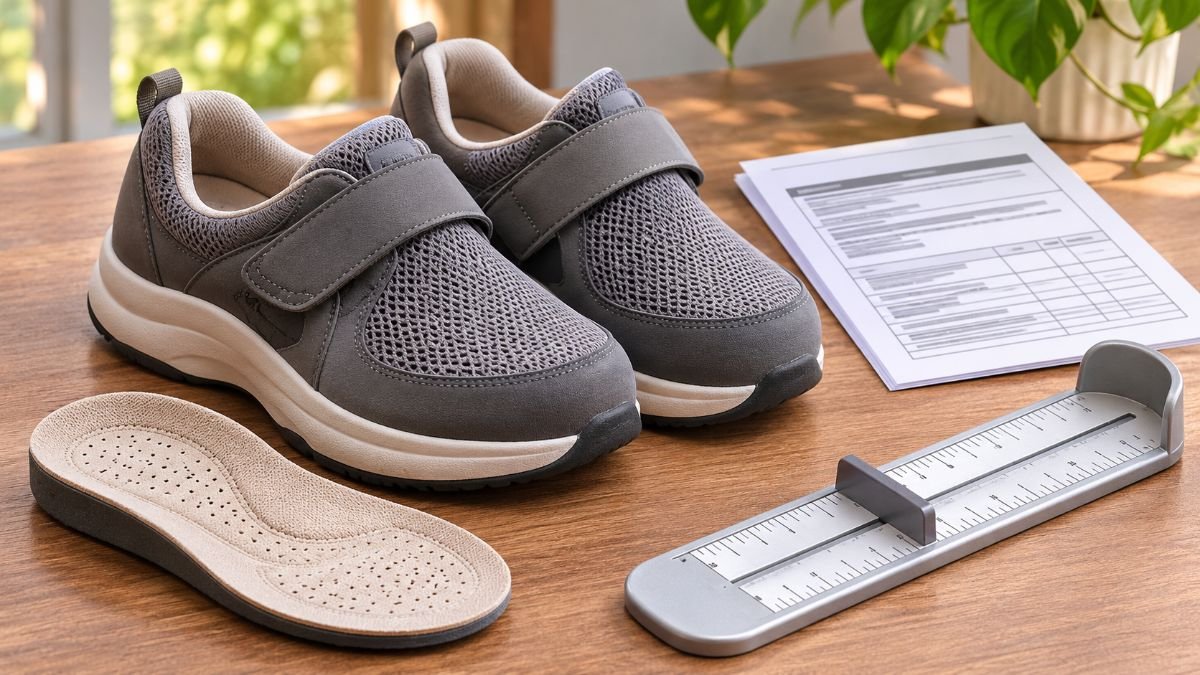
What IS 19956 Is, in Plain Language
India already had standards for sandals and slippers, sports shoes, safety shoes and school shoes, but nothing written specifically for footwear meant to protect a high-risk foot. IS 19956:2026 fills that gap. According to a TeamLease RegTech update, BIS established the standard on 14 October 2026, together with two unrelated standards for pedal-assisted bicycles and EV charging cables. The title is simply “Therapeutic Footwear”.
The work was done by the BIS sectional committee that handles assistive products, rehabilitation appliances and orthotic items (MHD 09). The committee put a draft out for public comment in July 2025, with comments due by 2 August 2025, and BIS held a “Manak Manthan” consultation on the draft at FDDI Hyderabad on 24 November 2025, as described on the FDDI news page. People from the footwear industry and training institutes suggested adding chemical requirements, defining open-type footwear and adding performance tests such as flexing resistance.
One honest point before going further: the numbers in this guide come from the July 2025 draft, which is the text that is publicly readable. The final published IS 19956:2026 may differ in details, so treat the figures as a guide to what the standard is built around, and check the official text on the BIS portal if you need exact values for compliance.
Why India Needed a Standard for Therapeutic Footwear
India has one of the largest populations of people with diabetes in the world, and the foot is where many of the worst complications show up. Nerve damage can remove the warning sign of pain, so a pressure spot or a small cut goes unnoticed and can turn into an ulcer. The International Working Group on the Diabetic Foot (IWGDF) 2023 guideline on preventing foot ulcers, published in Diabetes/Metabolism Research and Reviews, recommends that people at moderate-to-high risk wear therapeutic footwear that fits properly and accommodates any deformity. For people with a healed plantar ulcer, it goes further and says the footwear should have a demonstrated pressure-relieving effect.
Until now, a shop in India could call a soft slipper “diabetic” or “orthopedic” with nothing behind the word. A standard does not fix that overnight, but it gives manufacturers, labs and eventually regulators a common yardstick: what the shoe should be made of, how much room it should give, and how it should be tested. That is the first step toward labels that mean something.
Who Therapeutic Footwear Is Meant For
The draft scope is specific. It covers general and safety requirements for footwear designed for people with diabetes, neuropathic at-risk feet and a high risk of foot ulcers. That is a clinical group, not everyone with tired feet.
Who it is not aimed at
- Someone buying a comfortable house slipper for ordinary standing and walking.
- People with common heel pain, where the NHS advises supportive, cushioned footwear but does not describe it as therapeutic footwear.
- Children’s, sports, safety and school footwear, which have their own standards.
The distinction matters because the word “therapeutic” can slide into marketing. A standard that targets people with nerve damage does not make every cushioned slipper therapeutic. If you are shopping for comfort and have normal sensation, our guides to orthopedic slippers for men and orthopedic slippers for women are more relevant.
Soft Slippers Shoppers Often Compare
These are examples of soft everyday slippers listed online. They are general-purpose slippers, not prescription footwear and not claimed to meet IS 19956. If you are at risk of ulcers, ask your doctor first.

Doctor Extra Soft Ultra Cushion Slippers for Men
Listed as lightweight men’s slippers for orthopedic and diabetic use.
View on Amazon.in
Doctor Extra Soft House Slipper for Women
The listing mentions MCR, orthopaedic, diabetic and acupressure features.
Check size and price
Ortho Joy Orthopedic Soft Slippers for Ladies
Listed as an MCR chappal for women for daily use.
See it on Amazon.in
Frido Cloud Comfort Slippers for Women and Men
Listed with two options: with arch support and without. Pick deliberately.
Check the options
Ortho + Rest Ortho Slippers for Women
A women’s daily-use orthopedic flip-flop, per the listing.
See it on Amazon.in
Doctor Health Super Soft Men's EVA Flip Flops
A thong-style EVA (not MCR) men’s slipper, useful as a comparison for softness.
See it on Amazon.inTry them on in Chennai
If you are in Chennai, you can visit our Choolaimedu store (No. 223, Choolaimedu High Road, near Gangai Amman Kovil, Chennai 600094) to see MCR and MCP chappals in person. We are not a clinic, so please bring your doctor’s footwear advice if you have one. WhatsApp us to check what is in stock.
The Fit Rules in the Draft: Extra Length, Width and Depth
Fit is where therapeutic footwear differs most from an ordinary shoe, and the draft is concrete about it. As listed in the draft text:
| Measure | What the draft asks for |
|---|---|
| Length | 12.5 to 15.8 mm beyond the longest toe |
| Width | 12.7 mm beyond the widest part of the forefoot |
| Depth | 4.76 to 15.8 mm deeper than normal footwear |
| Insole thickness | 8 to 10 mm |
| Rocker angle | 15 to 20 degrees |
| Apex position | 52 percent of footwear length |
| Removable insoles | Extra depth or removable insoles so custom orthotics can be fitted, with good heel control |
Values are from the draft and may differ in the final standard.
Two of these terms are worth explaining. A rocker is a curved section of the sole under the forefoot that helps the foot roll forward, which reduces bending at the toes and can lower pressure under the ball of the foot. The apex is where that curve begins along the sole. Both are common in clinical offloading footwear. The depth allowance exists so that a thick insole or a custom orthotic can go in without the toes pressing on the top of the shoe.
The draft also refers to the Indian sizing standard IS 8751 (Part 1), which uses the mondopoint system, for fit and insole measurements. Mondopoint sizes are in millimetres, so a foot length can be matched to a shoe length directly instead of relying on a US or UK number.
Materials the Draft Allows
The material annex groups materials by part of the shoe. The draft lists leather, canvas, fabric or mesh for the outer layer, with reinforcement over the toes and heel cup; leather, rubber or polyurethane for the outsole; and for the insole, EVA, polyurethane foam or micro-cellular rubber. All three parts must be durable and washable.
That list matters for anyone who shops for MCR chappals, because micro-cellular rubber is named directly as an acceptable insole material. It does not mean every MCR slipper meets the standard. It means the material class is recognised for this use. If you want the background, read our guides on what MCR slippers are and on MCR versus EVA soles.
The Lab Tests and Their Limits
Here is what the draft asks a lab to measure.
| Test | Method or condition | Requirement in the draft |
|---|---|---|
| Abrasion | DIN abrasion tester, 40 rpm | Mass loss in the range 180 to 220 mg |
| Rebound resilience | Specimen about 11 mm thick | Rebound above 60 percent |
| Hardness | 23 degrees C, 50 percent humidity | 15 to 35 Shore A |
| Compression set | 50 percent compression, 6 hours at 50 degrees C, 30 minutes recovery | Formula given, no limit stated |
| Slip resistance | IS 8085 (Part 25) | No limit stated |
| Water absorption and desorption | Roller test, reported as g per square metre and percent | Reported, no limit stated |
| Antibacterial activity | ISO 16187:2013, at least six specimens | Test method specified |
| Dimensions, adhesion, peel, heat, ageing | IS 8085 (Part 1) | Method specified |
| Tensile strength and elongation | IS 8085 (Part 12) | Method specified |
Several tests are reported rather than pass or fail in the draft. Check the final text for limits.
Three points stand out. First, the hardness range of 15 to 35 Shore A is soft. For comparison, the MCR research behind Indian therapeutic sandals used soles of roughly 15 Shore A in the Leprosy Mission work and about 20 Shore in a Chennai study, as described in the 2014 Journal of Foot and Ankle Research paper and the 2004 Diabetes Care study. The standard sits in the same territory those programmes used.
Second, rebound above 60 percent is a test of how quickly the foam springs back, which relates to how it holds its cushioning over time. Third, the compression set test squashes a sample for six hours at 50 degrees C and measures how much thickness it fails to recover, which is a laboratory stand-in for the flattening you see in an old slipper.
A soft sole is not automatically a good one. Very soft foam can bottom out, and the draft pairs softness with rebound, compression and abrasion checks for that reason.
What the Marking Rules Say
The draft asks for footwear to be marked with the size, the type, the manufacturer or brand name, and optional marks: “CF 4” if colour fastness to light is claimed and “CR” if flexing resistance for cold regions is claimed. The BIS Standard Mark is described as optional and tied to conformity assessment schemes. In practice, this means a shopper should not expect to see an ISI mark on every therapeutic shoe even once the standard is in force. Whether certification becomes mandatory is a separate government decision, and the sources read for this guide do not say so either way.
What the Draft Leaves Open
A fair reading also means noting what the draft does not do.
- No named footwear types. “Type” is a required marking, but the draft does not define categories such as shoes, sandals or open-type footwear. Participants at the FDDI session asked for open-type footwear to be defined.
- No chemical requirements. Participants suggested adding them.
- No flexing resistance test in the draft.
- Slip, water absorption and compression set have methods but no pass limit in the draft.
- No clinical outcome test. The standard measures the shoe, not whether the shoe prevents ulcers. The IWGDF guideline notes that the pressure-relieving effect of footwear for people with a healed ulcer should be demonstrated, ideally by in-shoe pressure measurement, which is a clinical check outside a materials standard.
Whether the final text addressed these suggestions is something to confirm from the official document.
How IS 19956 Differs From the Slipper Standard IS 6721
Many readers will have heard of IS 6721:2023 for sandals and slippers. That standard covers general-purpose slippers and sets requirements such as sole properties, strap strength and slip behaviour. It does not define the labels MCR, MCP or “orthopedic”. IS 19956 is the one that is written for a clinical group, and it sets fit allowances, depth for orthotics and a narrower hardness range. A slipper can meet IS 6721 and still be nothing like therapeutic footwear. Our guide on MCR versus MCP explains why the letters on a label are not a safety guarantee.
| Point | IS 6721:2023 | IS 19956:2026 |
|---|---|---|
| Product | Sandals and slippers for general use | Therapeutic footwear |
| Intended wearer | General public | People with diabetes, neuropathy or high ulcer risk |
| Fit allowances | Not the focus | Length, width and depth allowances in the draft |
| Orthotic provision | Not required | Extra depth or removable insoles in the draft |
| Defines MCR or MCP | No | Lists micro-cellular rubber as an insole material |
What the Standard Does Not Replace
Standards are about products. Foot care is about a person. The IWGDF guideline recommends integrated foot care for people at moderate-to-high risk, meaning footwear plus foot examination, education and treatment of any pre-ulcer signs. It also advises against walking barefoot, in socks only or in thin-soled slippers. The Mersey Care NHS guidance on diabetes and foot care similarly advises checking feet every day and never walking barefoot.
If you have diabetes with numbness, tingling, burning, a past ulcer, a deformity or an amputation, see a doctor or podiatrist for an assessment. Therapeutic shoes for that group are normally prescribed and fitted after an assessment, and a certified shoe is a better starting point than an uncertified one, not a substitute for that assessment.
How to Shop Sensibly While Labels Catch Up
- Ask for the test or certification papers. If a seller claims the shoe meets IS 19956, ask for the manufacturer’s test report or certificate. The marking rules call for a manufacturer or brand name, so a bare, unbranded pair is a poor sign.
- Measure both feet in the evening. Feet swell through the day. Use a measured length, not just a size number, and leave room beyond the longest toe.
- Check depth with your hand. Run a hand inside for seams, stitches and ridges. Make sure there is room for a removable insole.
- Press the sole. Press a thumb into the foam for two seconds. A good sole springs back quickly. Our press test guide shows how.
- Look for a fastening such as laces or Velcro rather than a slip-on, so the foot stays put.
- Replace worn pairs. Compressed foam and a worn outsole are exactly what the lab tests are trying to predict.
- Do not self-diagnose. Numbness or a wound means see a doctor first.
What It Means for Chennai and Indian Shoppers
India has decades of experience with therapeutic footwear in leprosy and diabetes programmes. The Leprosy Mission work reported by Paul and colleagues describes over a million pairs of MCR insoles supplied in one programme, and a Chennai study of people with neuropathic diabetic feet found fewer new lesions in people wearing therapeutic footwear than in people wearing their own. A national standard gives that practical experience a formal place, and it is likely to help manufacturers who already make good products stand apart from those who do not.
For now, most slippers on shop shelves, including the MCR chappals you see everywhere, are general-purpose products and are not sold as certified therapeutic footwear. That is fine for people with healthy feet. It is a reason for anyone in the high-risk group to get advice first. If you are in Chennai and are buying for a parent or relative with diabetes, bring their doctor’s footwear advice to our Choolaimedu shop and we will help you match it to what is on the shelf. We are a footwear shop, not a clinic.
Common Misunderstandings
- “IS 19956 means all diabetic slippers are now certified.” No. The standard exists, but products are not certified just because the standard does.
- “MCR means therapeutic.” MCR is a material. The draft lists it as one acceptable insole material, nothing more.
- “Softer is safer.” The draft sets a range of 15 to 35 Shore A and also requires rebound and compression checks.
- “A certified shoe replaces a doctor.” It does not. The shoe is one part of foot care.
- “The numbers in this article are final.” They come from the July 2025 draft. Always confirm with the official text.
Frequently Asked Questions
What is IS 19956?
IS 19956:2026 is the Bureau of Indian Standards specification for therapeutic footwear. Reports say BIS established it on 14 October 2026. It covers general and safety requirements and test methods for footwear designed for people with diabetes, neuropathic at-risk feet and a high risk of foot ulcers.
Who is therapeutic footwear for?
The draft scope names people with diabetes, nerve damage in the feet and a high risk of foot ulcers. It is not meant for ordinary comfort shopping. A doctor or podiatrist should assess anyone with numbness or a past ulcer.
Is IS 19956 mandatory?
The sources read for this guide do not say. The draft describes the BIS Standard Mark as optional under conformity assessment schemes. Whether certification is made compulsory is a separate government decision.
What materials does the draft allow?
The draft lists leather, canvas, fabric or mesh for the outer layer, leather, rubber or polyurethane for the outsole, and EVA, polyurethane foam or micro-cellular rubber for the insole. All parts must be durable and washable.
What hardness does the draft set for soles?
The draft sets 15 to 35 Shore A, measured at 23 degrees C and 50 percent humidity, along with a rebound above 60 percent.
Does the standard prove a shoe prevents ulcers?
No. It tests the shoe, not clinical outcomes. The IWGDF guideline says footwear for people with a healed ulcer should have a demonstrated pressure-relieving effect, ideally checked with in-shoe pressure measurement.
Are MCR slippers covered by IS 19956?
Micro-cellular rubber is listed as an acceptable insole material in the draft. An MCR slipper is not automatically therapeutic footwear. It would still need to meet the fit, test and marking requirements.
How is IS 19956 different from IS 6721?
IS 6721:2023 covers sandals and slippers for general use. IS 19956 is written for a clinical group and includes fit allowances, depth for orthotics and a narrower hardness range.
The Short Version
IS 19956:2026 is a welcome step: India now has a written yardstick for footwear meant to protect high-risk feet, with fit allowances, materials and lab tests. It is a standard for the product, not a replacement for a foot assessment, and the figures in this guide come from the July 2025 draft. If you have diabetes with numbness or a past ulcer, start with a doctor or podiatrist. If your feet are healthy, use the buying checks above and choose a closed, well-fitting, cushioned pair.
Keep Reading
Chennai
Sources
- TeamLease RegTech: BIS notification establishing IS 19956:2026 Therapeutic Footwear, 14 October 2026
- BIS: Draft Indian Standard, Therapeutic Footwear Specification (MHD 09), July 2025
- BIS: IS 6721:2023 Sandals and Slippers, Specification (First Revision)
- IWGDF: Guidelines on the prevention of foot ulcers in persons with diabetes, 2023 update
- Viswanathan et al.: Effectiveness of different types of footwear insoles for the diabetic neuropathic foot, Diabetes Care 2004
- Paul, Rajkumar, Mendis: Micro Cellular Rubber (MCR), a boon for leprosy affected patients, J Foot Ankle Res 2014
- FDDI Hyderabad: Manak Manthan on the draft Therapeutic Footwear standard
- PubMed: IWGDF 2023 guideline on prevention of foot ulcers in persons with diabetes
- Mersey Care NHS: Diabetes and foot care
Some links on this page are affiliate links, so we may earn a small commission on qualifying purchases at no extra cost to you. See our affiliate disclosure. Foot-health content here is general information, not medical advice.


