
MCR vs MCP Slippers: What the Labels Mean and How to Choose Between Them
Quick answer: MCR means micro cellular rubber, a soft rubber foam. MCP has no single agreed definition: Indian sellers explain it as micro cellular polymer, polyurethane or a firmer rubber-like foam, and the same word is used differently from shop to shop. So do not buy on the letters. Ask what the sole is made of, press it, check how it springs back, and ask your doctor if you have diabetes or numb feet.
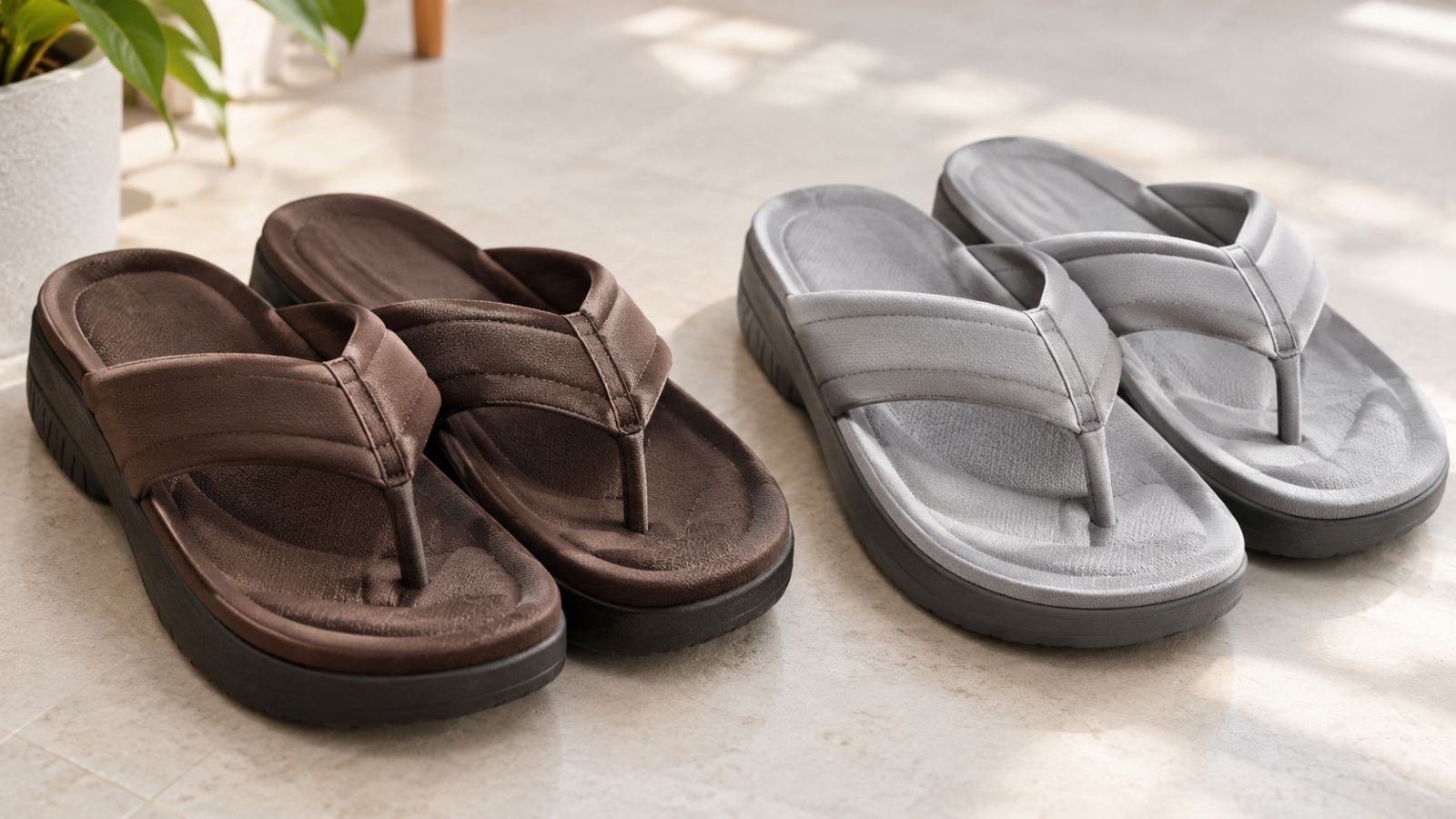
What MCR Is
MCR stands for micro cellular rubber. The Indian MCR programme described in a 2014 paper in the Journal of Foot and Ankle Research uses natural rubber compounded with chemicals into sheets of about 15 Shore A hardness, used for insoles and footwear. Cells in the foam make it soft and springy, and the material is lighter than solid rubber. A separate engineering study of therapeutic sandals in Chennai reported a sole softness of around 20 Shore.
So MCR is a real, described material. The catch is that a slipper sold as “MCR” can still range from very soft to quite firm, depending on the compound and density.
What MCP Means, and Why It Varies
MCP is a trade term. Sellers in India commonly spell it out as micro cellular polymer, polyurethane or a firmer rubber-like foam. Different pages online describe it in opposite ways: one says MCP is firmer and made for diabetic feet, another says it is the softer, lighter EVA-type material. No standard or published paper fixes the meaning.
That is why we do not claim MCP is better or worse than MCR. The honest position is that the letters tell you very little, and the material, density and shape tell you a lot.
Why Sellers Use Different Words
Footwear sellers rely on shorthand terms. “MCR” is a recognised material name in India’s therapeutic footwear work, but “MCP” has been used by manufacturers and sellers for their own foam grades. Because no standard fixes the meaning, two sellers can honestly describe different products with the same letters. That is why this guide leans on tests you can do instead of definitions you cannot verify. If you want a clearer picture of the comparison with a plastic-type foam, read our MCR vs EVA guide.
Cushioned Slippers online
Examples listed online. Check the product page for the sole material, and press-test when you can.

Doctor Extra Soft Ultra Cushion Slippers for Men
Listed as lightweight men’s slippers for orthopedic and diabetic use.
View on Amazon.in
Doctor Extra Soft House Slipper for Women
The listing mentions MCR, orthopaedic, diabetic and acupressure features.
Check size and price
Ortho Joy Orthopedic Soft Slippers for Ladies
Listed as an MCR chappal for women for daily use.
See it on Amazon.in
MCR Healthcare Women's Orthopedic Soft Slippers
Listed as lightweight women’s chappals/sandals/slippers for orthopedic and diabetic use.
Compare on Amazon.in
Doctor Health Super Soft Men's EVA Flip Flops
A thong-style EVA (not MCR) men’s slipper, useful as a comparison for softness.
See it on Amazon.in
Doctor Health Super Soft Women's Orthopedic Soft Platform Slippers
Listed as ultra-cushioned platform slippers. Check the base width for stability.
See it on Amazon.inTry them on in Chennai
If you are in Chennai, the easiest way to compare is by hand. Visit our Choolaimedu store (No. 223, Choolaimedu High Road, near Gangai Amman Kovil, Chennai 600094) and press MCR and MCP chappals side by side. WhatsApp us to check what is in stock.
What the Indian Slipper Standard Says (and Does Not)
India has a national standard for slippers: IS 6721:2023, Sandals and Slippers, First Revision, issued by the Bureau of Indian Standards. It covers all varieties of sandals and slippers, whether fully moulded or assembled, and it sets requirements for materials, construction, performance, chemical content, marking and sampling. You can read the document on the BIS website.
What matters for this guide is what the standard does not do. It allows bottom and mid soles to be “any natural or synthetic material, solid or cellular”, and it does not name rubber, EVA or microcellular rubber as material types. It also does not set a Shore A hardness value. So the letters MCR and MCP are not defined by this standard, and neither is “soft”. What it does define are performance tests, including:
- Density: cellular non-leather outsoles are expected to be below 0.90 g/cm³, and solid ones at least 0.90 g/cm³.
- Abrasion: a maximum volume loss of 600 mm³ for cellular soles and 350 mm³ for solid ones.
- Flexing: no spontaneous crack after 30,000 flexes for non-rigid soles.
- Strap strength: the strap-to-sole attachment has to withstand 100 to 200 N depending on strap width, and a back strap or hook-and-loop attachment at least 100 N.
- Slip resistance: a coefficient of friction of at least 0.3 on quarry tile, dry and wet.
A pair that carries the BIS mark has been tested against such requirements. Use of the mark is optional under certification schemes, so its absence does not mean a pair is unsafe, and its presence does not tell you whether the sole is MCR, MCP or EVA. It tells you the pair meets tests for strength and durability.
How MCR and MCP Compare
| Point | MCR | MCP |
|---|---|---|
| Meaning | Micro cellular rubber (a described material) | No standard meaning; varies by seller |
| Typical feel | Soft, springy, can be firm or soft by grade | Varies from soft to firm by seller |
| Weight | Lighter than solid rubber | Often described as light |
| Evidence | Studied in India for insoles and therapeutic sandals | No studies use this label |
| Best test | Press and rebound | Press and rebound |
The word on the box is not proof of what is under your foot.
Hardness, Density and Thickness: The Three Numbers That Matter
| Number | Why it matters | What a seller can say |
|---|---|---|
| Hardness (Shore A) | Lower is softer. Research MCR sheets for insoles were around 15 Shore A, and Chennai sandal research cites around 20 Shore | Many shop slippers do not state it. If they do, you can compare pairs |
| Density | Denser foam resists flattening under body weight | Often not stated, but you can feel it in weight and rebound |
| Thickness at the heel | Gives cushioning without bottoming out | Millimetres, if the listing is honest |
Shore A is a scale on which higher numbers mean harder material. Compare like with like.
A soft grade is not automatically better. A very soft foam can feel luxurious in the shop and feel flat in three months, particularly under heavier body weight. If you want a pair for standing hours, ask for a firmer, denser grade, whatever the letters on the box say.
Decoding a Listing: Phrases and What to Do With Them
| Phrase | What it can mean | What to do |
|---|---|---|
| MCR sole | Micro cellular rubber, or a seller’s shorthand for any soft rubber-like sole | Press and check rebound |
| MCP sole | A foam grade defined by the seller | Ask what it is made of |
| Orthopedic | Soft, shaped footbed | Check shape, heel strap and sole |
| Doctor soft | Very soft grade | Check it recovers and is not too thin |
| Anti-skid | Tread pattern | Look at the pattern and test on a wet floor |
| Lightweight | Cellular foam, low density | Great for comfort, check how it ages |
Labels are claims, not tests. If a claim matters to you, ask how it is checked.
If a listing for a slipper has a BIS mark, a stated size chart in centimetres and a clear material, it is already ahead of most. If it only has adjectives, assume the adjectives are the product.
A Four Step Test That Works on Any Pair
- Ask the material. A good seller can say what the sole is made of.
- Press with your thumb. It should dent and spring back slowly, not stay dented.
- Watch the rebound. Heavier wearers need a denser sole that holds its shape; see our men’s guide.
- Compare weight and shape. A gentle heel and arch contour matters more than the label.
Choosing by Use, Not by Letters
| Your situation | What to look for |
|---|---|
| Light use at home | Softer grade is fine, check the strap and tread |
| Standing hours on tile | Denser grade, shaped footbed, back strap |
| Heavier body weight | Dense, firm foam that rebounds. Compare by pressing |
| Bathroom or rain | Channelled tread, rinseable footbed, no peeling layers |
| Older family member | Closed or strapped heel, firm non-slip sole, easy fastening |
Whichever label is on the box, the same test applies: press, hold, release, and check the dent.
Common Myths About MCR and MCP
- “MCP is a better version of MCR.” Nothing in published standards says so.
- “MCR is only for patients.” It started in medical programmes but soft cellular rubber is used in everyday chappals.
- “MCP means medical grade.” No published standard defines MCP as a medical grade.
- “A higher price means better foam.” Price reflects many things. Feel the rebound.
A Worked Example: Comparing Two Pairs in the Shop
Say you are choosing between a pair labelled MCR and another labelled MCP, both brown slides in your size. Here is a way to decide in about five minutes without relying on either label.
- Weigh them in your hands. The lighter one has the lower-density foam. That is not better or worse, but it tells you which will flatten sooner.
- Press the heel area of each with your thumb for two seconds. Note how deep the dent goes and how fast it recovers.
- Flex the sole. It should bend near the ball of the foot, not in the middle.
- Put both on and stand. Does the foot feel supported or does it sink?
- Walk ten steps on the shop floor. Notice slipping or toe gripping.
- Turn them over. Compare the tread pattern and depth.
Whichever one passes more of these is the better pair for you, whichever letters are on it. If both pass equally, choose on price and strap comfort.
If a Pair Flattens Early
A pair that goes flat within weeks is usually too soft for your weight or has been worn every day without a rest. Try a firmer, denser grade next time, and rotate two pairs. Keep the receipt: a sole that compresses permanently within a month is a quality problem worth raising with the seller.
If You Have Diabetes or Numb Feet
Do not choose by letters. In the 2004 Chennai study, prescribed therapeutic sandals had lower plantar pressures than the participants’ own footwear, and the authors reported new lesions in 33 percent of those using their own footwear against 4 percent of the others. Those were prescribed, assessed products. The IWGDF 2023 guideline advises people at risk of diabetic foot ulcers not to walk barefoot, in socks only, or in thin-soled slippers, and to wear properly fitting footwear. See our diabetic slippers guide.
Who Should Ask a Doctor First
Ask your doctor before choosing by label if
- You have diabetes with numb or at-risk feet. IWGDF 2023 advises such people to wear properly fitting footwear, not thin-soled slippers, and not to walk barefoot.
- Pain has lasted more than two weeks.
- You have a wound, swelling or a deformity.
A Chennai study of prescribed therapeutic MCR sandals reported lower plantar pressures than the participants’ own footwear, but those were prescribed, not shop slippers.
Making Either Last Longer
- Dry in shade and rotate two pairs.
- Avoid leaving them in a hot parked vehicle.
- Wipe the footbed with a damp cloth. Do not use harsh solvents.
- Replace once the heel area has a permanent dent.
Sizing Foam Slippers Correctly
Foam soles cannot be stretched, so the size has to be right from the start. Measure your foot in the evening, heel to longest toe, and compare it with the footbed length in centimetres. India’s sizing numbers came from other systems and do not always match Indian feet; CSIR-CLRI measured about 1.25 lakh people across 79 districts for that reason, according to a Free Press Journal report. Your heel should sit fully on the footbed and your toes should not hang over the front edge. If you are between sizes and the strap is adjustable, go up.
Sweat, Smell and Foot Hygiene in Foam Footwear
Foam soles are easy to wipe, but a damp footbed in a humid city can hold moisture and smell. The NHS says athlete’s foot is more likely when feet are wet or sweaty, and advises drying thoroughly between the toes, not wearing the same shoes more than two to three days in a row, and wearing flip-flops in shared wet areas. See the NHS athlete’s foot page. Rotate two pairs, let each dry fully in shade, and wash the footbed with mild soap. Do not share slippers.
Buying Decisions Made Simple
- Ignore which letters are on the box until you have pressed the sole.
- Pick the thickness and firmness for your weight and your day.
- Choose a strap that holds the heel.
- Check tread for wet floors. The BIS standard’s slip test uses quarry tile at 0.3 minimum friction, which is a very basic requirement, so look at the pattern yourself.
- Buy from a seller who answers questions about the sole plainly.
At our Choolaimedu store in Chennai, we can show MCR and MCP-labelled pairs side by side so you can compare weight, rebound and thickness in your hands.
Frequently Asked Questions
What is the difference between MCR and MCP slippers?
MCR is micro cellular rubber. MCP has no standard meaning and sellers define it differently, so compare the actual sole.
What does MCP stand for in slippers?
Commonly micro cellular polymer or polyurethane, but usage varies by seller.
Which is better, MCR or MCP?
Neither label proves better. Compare softness, rebound and fit by hand.
Which is better for diabetics?
Ask your doctor. Prescribed therapeutic footwear is different from shop slippers.
Which is better for heel pain?
A soft, well-shaped sole helps comfort, but no study shows either label treats heel pain. See a doctor if pain lasts two weeks.
Is MCR softer than EVA?
It depends on the grade. See our guide on MCR slippers for how to check.
How do I check a sole is not too soft?
Press with a thumb: it should spring back. Heavier wearers need a denser sole.
Where can I compare MCR and MCP chappals in Chennai?
Urban Style Footwear, Choolaimedu. WhatsApp +91 90808 61559.
The Short Version
Do not buy on the letters. MCR is a described material, MCP is a trade term, and both come in soft and firm versions. Ask, press, check the rebound, and see a doctor if your feet are at risk.
Keep Reading
Related guides
Sources
- Paul, Rajkumar, Mendis: Micro Cellular Rubber (MCR), a boon for leprosy affected patients, J Foot Ankle Res 2014
- Viswanathan et al.: Effectiveness of different types of footwear insoles for the diabetic neuropathic foot, Diabetes Care 2004
- IWGDF: Guidelines on the prevention of foot ulcers in persons with diabetes, 2023 update
- Charanya et al.: Footwear for diabetic neuropathic feet, Proc Inst Mech Eng H 2004
- BIS: IS 6721:2023 Sandals and Slippers, Specification (First Revision)
- NHS: Athlete’s foot
- Free Press Journal: CSIR-CLRI foot measurement and sizing initiative
Some links on this page are affiliate links, so we may earn a small commission on qualifying purchases at no extra cost to you. See our affiliate disclosure. Foot-health content here is general information, not medical advice.


