
MCR vs EVA Slippers: How the Two Soles Differ and Which to Choose
Quick answer: neither material wins by name. MCR is a micro cellular rubber foam, EVA is a lightweight plastic-like foam. Both come soft or firm, and both flatten with use. Pick on density and shape: a thumb press that springs back, a stable base and a back strap. Heavier wearers and long standing hours should lean to denser grades.
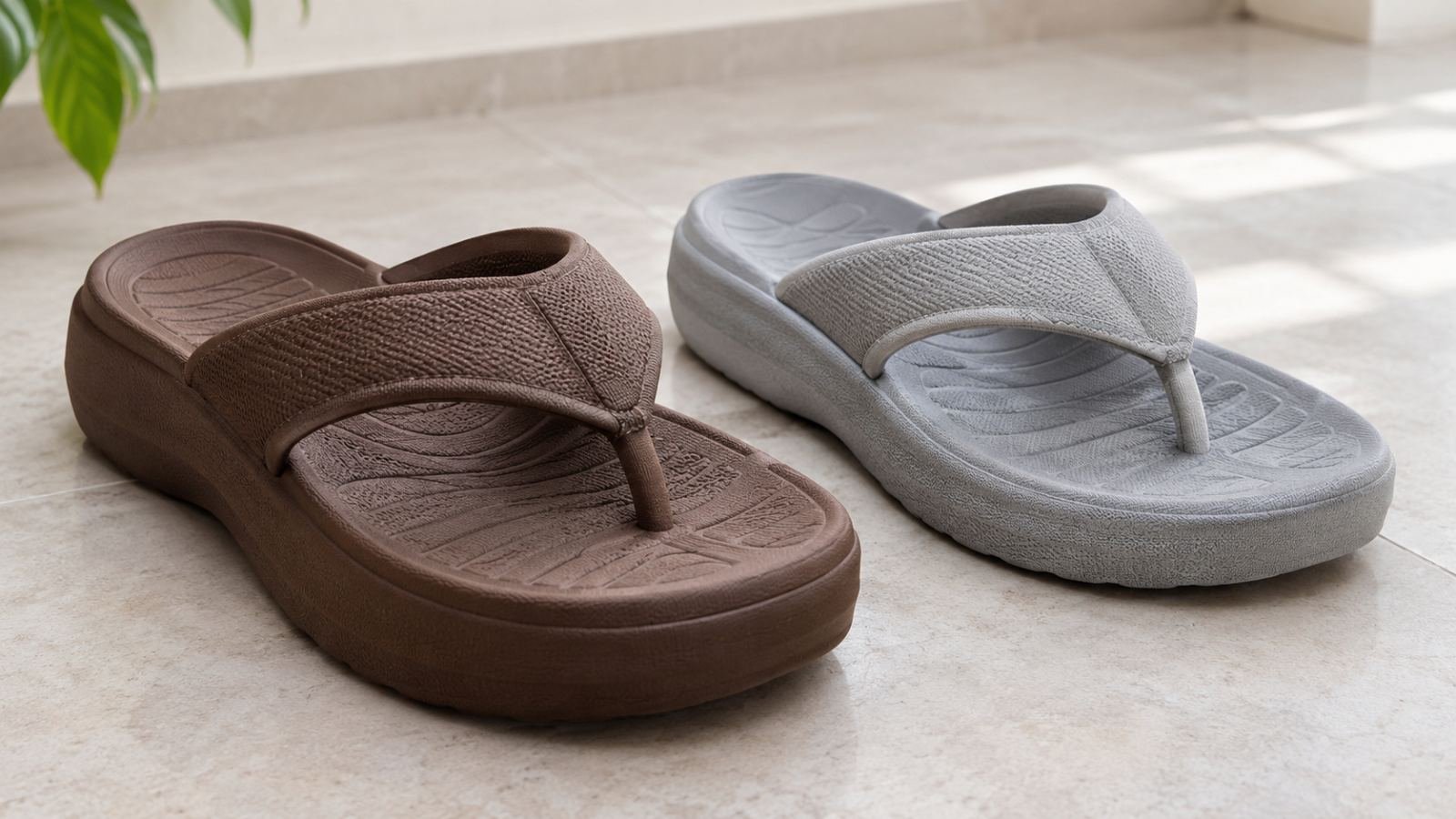
What Each Material Is
MCR is micro cellular rubber: natural rubber compounded with chemicals into a foam with tiny cells, described in the Indian MCR programme as sheets of around 15 Shore A hardness for insoles and footwear.
EVA is ethylene vinyl acetate, a foam copolymer that is neither pure rubber nor pure plastic. Footwear sources describe it as a closed-cell foam that is light and cushioned, and note that density can be tuned from soft to firm.
What “Closed Cell” and “Cellular” Mean
Both materials are foams: they contain gas-filled cells, which is what makes them light and cushioned. In a closed-cell foam, the cells are sealed, so the material does not soak up water the way an open sponge does. Footwear industry sources such as Shoemakers Academy and Atoms describe EVA as a closed-cell foam, and note that its cushioning compresses over time, especially in softer grades. MCR is also a cellular material, made from natural rubber compounded with chemicals into sheets or soles.
The Indian slipper standard, IS 6721:2023, treats cellular soles as a category by structure rather than by brand. It says non-leather outsoles should have a density below 0.90 g/cm³ if cellular and at least 0.90 g/cm³ if solid, and caps abrasion volume loss at 600 mm³ for cellular soles against 350 mm³ for solid ones. It does not name EVA, rubber or microcellular rubber as material types and does not set a Shore A hardness. See the document on the BIS website. In other words, the standard measures what a sole does, not what it is called.
Side by Side
| Point | MCR | EVA |
|---|---|---|
| Material | Rubber foam | Plastic-like foam |
| Weight | Light | Usually lighter |
| Feel | Soft and springy, grade dependent | Soft to firm, grade dependent |
| Ageing | Compresses with use | Compresses with use; industry sources note progressive flattening, mainly in soft grades |
| Wet floors | Check the tread, not the label | Check the tread, not the label |
| Evidence for foot conditions | Used in Indian therapeutic footwear programmes | No special evidence for slippers |
No study ranks one above the other for everyday slippers.
MCR and EVA Style Slippers online
Examples listed online. Check the product page for the sole material and press-test when you can.

Doctor Extra Soft Ultra Cushion Slippers for Men
Listed as lightweight men’s slippers for orthopedic and diabetic use.
View on Amazon.in
Doctor Extra Soft House Slipper for Women
The listing mentions MCR, orthopaedic, diabetic and acupressure features.
Check size and price
Ortho Joy Orthopedic Soft Slippers for Ladies
Listed as an MCR chappal for women for daily use.
See it on Amazon.in
Doctor Health Super Soft Men's EVA Flip Flops
A thong-style EVA (not MCR) men’s slipper, useful as a comparison for softness.
See it on Amazon.in
Doctor Health Super Soft Women's Orthopedic Soft Platform Slippers
Listed as ultra-cushioned platform slippers. Check the base width for stability.
See it on Amazon.in
Health Fit Extra Soft Diabetic and Orthopedic Slippers for Men
Listed as extra soft diabetic and orthopedic slippers for men.
See it on Amazon.inTry them on in Chennai
If you are in Chennai, visit our Choolaimedu store (No. 223, Choolaimedu High Road, near Gangai Amman Kovil, Chennai 600094) and press MCR and other foam soles side by side. WhatsApp us to check what is in stock.
How Soles Age
All foam soles lose thickness as the cells compress. Industry material sources note that EVA can lose cushioning over months of regular use, and that higher density and better cross-linking slow this. The same idea applies to MCR: a very soft grade will flatten faster than a denser one, especially under heavier body weight. If a slipper feels great in the shop but is flat in three months, density is the usual reason.
What a Proper Lab Comparison Would Measure
Nobody has published a head-to-head of everyday MCR and EVA slippers, but it helps to know what such a test would look at, because these are the same properties you are judging by feel in the shop.
| Property | What it tells you | Your shop-floor version |
|---|---|---|
| Hardness (Shore A, with a durometer) | How firm the surface is | Thumb press |
| Density (g/cm³) | How much foam is in a given volume | Weight in your hand |
| Compression set | How much of the dent stays after a load is removed | Press, hold two seconds, release, watch the dent |
| Abrasion loss (mm³) | How fast the outsole wears | Look for a thick tread layer, not a thin skin |
| Flex endurance | Cracking after repeated bending | Bend it and look for white stress lines |
| Slip resistance (friction coefficient) | Grip on wet and dry tile | Tread pattern and a test on a wet floor |
IS 6721:2023 names several of these tests (density, abrasion, flexing, slip resistance) for slippers and sandals.
The durometer method for Shore hardness is referenced in the standard, but no numeric hardness requirement is set, which is why one brand’s “soft” and another’s “soft” can differ a great deal.
Five Tests You Can Do in the Shop
- Weigh each in your hand. Heavier usually means denser, so it will resist flattening longer.
- Press and release. A good sole dents and recovers. A sole that stays dented is too soft or tired.
- Bend it. It should flex near the ball of the foot. A sole that bends in the middle gives little support.
- Scratch the surface lightly with a fingernail. A foam that crumbles or marks easily may wear fast.
- Check the tread. A smooth foam sole is slippery on wet tile whatever the material.
Wet Floors, Rain and Bathrooms
Neither material wins on grip by name. The BIS standard sets a minimum coefficient of friction of 0.3 on quarry tile, dry and wet, as the test for slip resistance. That is a floor-level requirement, and real bathrooms are slicker than a laboratory quarry tile with a film of soap on them. Choose a pair with a channelled or patterned outsole for wet use, and keep it separate from the pair you use for resting at home.
Heat, Sun and Storage
Foam soles can warp when they sit in a hot closed car or in direct summer sun on a terrace. This applies to both materials. Keep slippers in shade, away from heaters, and do not stack heavy objects on them. If a sole has curled at the edge from heat, it will not recover.
Foot Health Notes
No published study ranks MCR above EVA, or the reverse, for foot pain or foot conditions. For heel pain, the NHS advises wide, comfortable shoes with a low heel and a soft sole, and soft insoles or heel pads, which either material can offer if the grade is right. See the NHS heel pain page. For people with diabetes at risk of foot ulcers, the IWGDF 2023 guideline advises against walking barefoot, in socks only or in thin-soled slippers, and recommends properly fitting footwear, whatever the material. If you have numb feet, a wound or lasting pain, ask your doctor or podiatrist before choosing a slipper.
How Long Does Each Last?
No one can promise a lifespan, because it depends on body weight, hours worn, the floor and heat. There are useful clues, though. In a study of ready-made MCR footwear in people with numb feet, Govindharaj and colleagues reported in Leprosy Review in 2017 that 66.4 percent of 125 participants were still wearing it six months or more later and described the footwear as durable. That is not a head-to-head with EVA, but it shows that a well-made rubber foam sole can hold up in regular use. For EVA, industry sources describe progressive compression over months, with higher density and better cross-linking slowing it. In both cases, the denser the foam, the longer it keeps its shape, and a second pair to alternate adds months to both.
Which Is Better for Which Person
| Wearer | Leans towards | Reason |
|---|---|---|
| Light person, short wear at home | Softer MCR or EVA | Foam will not bottom out under light weight |
| Someone on tile all day | Firmer, denser grade of either | Resists flattening and keeps support |
| Heavier wearer | Dense and firm of either | Soft foam flattens faster under higher load |
| Older family member | Firm sole, closed or strapped heel | Stability matters more than softness |
| Child | Light, flexible and easy to fasten | Growing feet need room, replace often |
| Person with diabetes or numb feet | Ask a doctor first | Prescribed footwear may be needed |
These are practical suggestions based on how foam behaves, not medical advice.
How to Read a Listing for Either Material
- Material line. “EVA”, “rubber” or “MCR”. If it only says “premium foam”, ask.
- Thickness. A millimetre figure at the heel is more useful than a description.
- Weight. A heavier slipper in the same size is usually denser.
- Tread description. Look for a deep pattern, not just “anti-skid”.
- Size chart in cm. The number on the sole is only a label.
Sizing Foam Slippers Correctly
Foam soles cannot be stretched, so the size has to be right from the start. Measure your foot in the evening, heel to longest toe, and compare it with the footbed length in centimetres. India’s sizing numbers came from other systems and do not always match Indian feet; CSIR-CLRI measured about 1.25 lakh people across 79 districts for that reason, according to a Free Press Journal report. Your heel should sit fully on the footbed and your toes should not hang over the front edge. If you are between sizes and the strap is adjustable, go up.
Sweat, Smell and Foot Hygiene in Foam Footwear
Foam soles are easy to wipe, but a damp footbed in a humid city can hold moisture and smell. The NHS says athlete’s foot is more likely when feet are wet or sweaty, and advises drying thoroughly between the toes, not wearing the same shoes more than two to three days in a row, and wearing flip-flops in shared wet areas. See the NHS athlete’s foot page. Rotate two pairs, let each dry fully in shade, and wash the footbed with mild soap. Do not share slippers.
The Two-Pair Habit
If there is one habit that makes the biggest difference to how long foam slippers last, it is rotation. Foam recovers its shape slowly after compression, so a pair worn every day never fully rebounds, while two pairs worn on alternate days do. It also lets each footbed dry out. It costs a little more up front and saves money over a year.
Myths About MCR and EVA
- “EVA is cheap plastic and MCR is premium rubber.” Both come in good and poor grades.
- “MCR never flattens.” Every foam compresses with use.
- “EVA is waterproof so it is safe on wet floors.” Water resistance and grip are different things.
- “The softest sole is the most comfortable.” It is the softest at first. After a few weeks it may be the flattest.
Price and Value
Because the labels are not graded, price is a weak signal. A cheap pair of dense, thick foam may outlast an expensive pair of very soft foam. If you want one rule, buy the pair that feels springy and firm under your weight at a price you are comfortable replacing, and expect to replace any foam slipper within a year or two of daily wear.
Questions People Ask Us at the Counter
Can I wash foam slippers? Yes, with plain water and mild soap. Dry in shade, not on a hot roof.
Why does my new pair squeak? Usually moisture between the footbed and the sole, or friction against a wet floor. It often settles after a few wears.
Why did the sole curl? Heat. A hot car or direct sun can warp foam permanently.
Should I buy a size up for foam soles? Not necessarily. Measure your foot and compare to the footbed length. A slipper that is too big flaps, which adds toe gripping.
Which to Pick
- Heavier wearers or long standing hours: choose a denser, firmer grade in either material.
- Light wear at home: a softer grade is fine.
- Wet bathroom floors: look at tread and a back strap; see our men’s and women’s guides.
- Diabetes or numb feet: ask your doctor before choosing by material. IWGDF 2023 advises against thin-soled slippers for people at risk of foot ulcers.
Confused by the other label? Read MCR vs MCP.
Trying Both in Chennai
At Urban Style Footwear in Choolaimedu, you can pick up MCR and EVA-type pairs side by side and compare their weight, rebound and tread. Bring the pair you are replacing so we can look at how and where it has worn. A worn heel on one side says more about your gait than any label.
Frequently Asked Questions
Is MCR better than EVA?
Not by name. Both come soft or firm. Compare density, rebound and shape.
Which lasts longer, MCR or EVA?
It depends on the grade and your weight. Denser soles hold their shape longer in both materials.
Is EVA good for heel pain?
A soft, shaped sole helps comfort, but no study shows EVA or MCR treats heel pain. See a doctor if pain lasts two weeks.
Which is better for diabetics?
Ask your doctor. Therapeutic footwear is prescribed, not chosen by material name.
Which is lighter?
EVA is usually lighter, but weights vary by design.
Are EVA slippers waterproof?
EVA is a closed-cell foam that does not absorb much water, but grip on wet tile depends on the tread.
How do I test the sole?
Press with your thumb. It should dent and spring back slowly.
Where can I compare soles in Chennai?
Urban Style Footwear, Choolaimedu. WhatsApp +91 90808 61559.
The Short Version
Choose the density and the shape, not the name. Press the sole, check the rebound and the strap, and replace the pair when it goes flat.
Keep Reading
Related guides
Sources
- Paul, Rajkumar, Mendis: Micro Cellular Rubber (MCR), a boon for leprosy affected patients, J Foot Ankle Res 2014
- IWGDF: Guidelines on the prevention of foot ulcers in persons with diabetes, 2023 update
- Atoms: What is EVA material, the complete guide (2026)
- Shoemakers Academy: What is the right foam for shoes?
- BIS: IS 6721:2023 Sandals and Slippers, Specification (First Revision)
- NHS: Heel pain
- NHS: Athlete’s foot
- Free Press Journal: CSIR-CLRI foot measurement and sizing initiative
Some links on this page are affiliate links, so we may earn a small commission on qualifying purchases at no extra cost to you. See our affiliate disclosure. Foot-health content here is general information, not medical advice.


